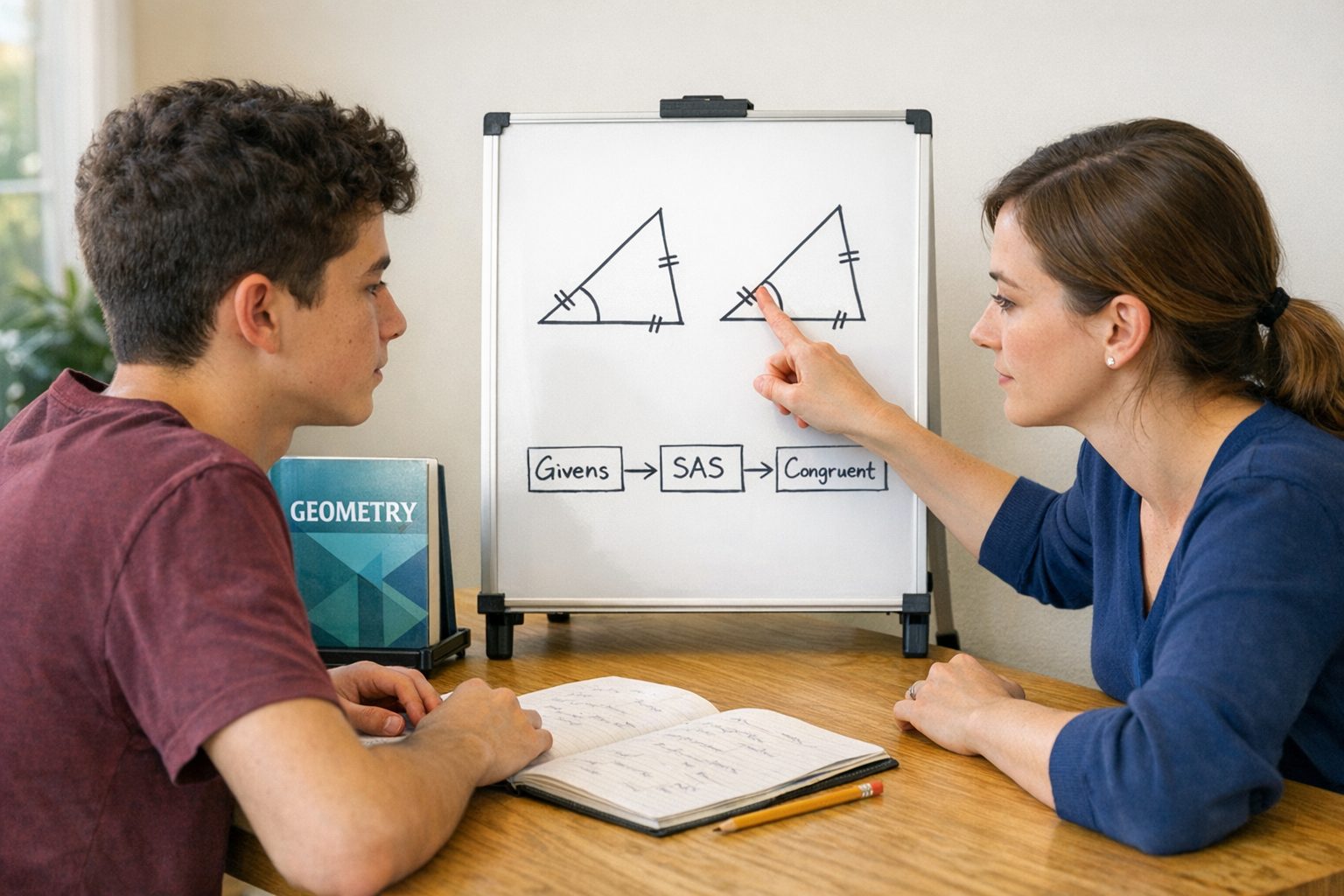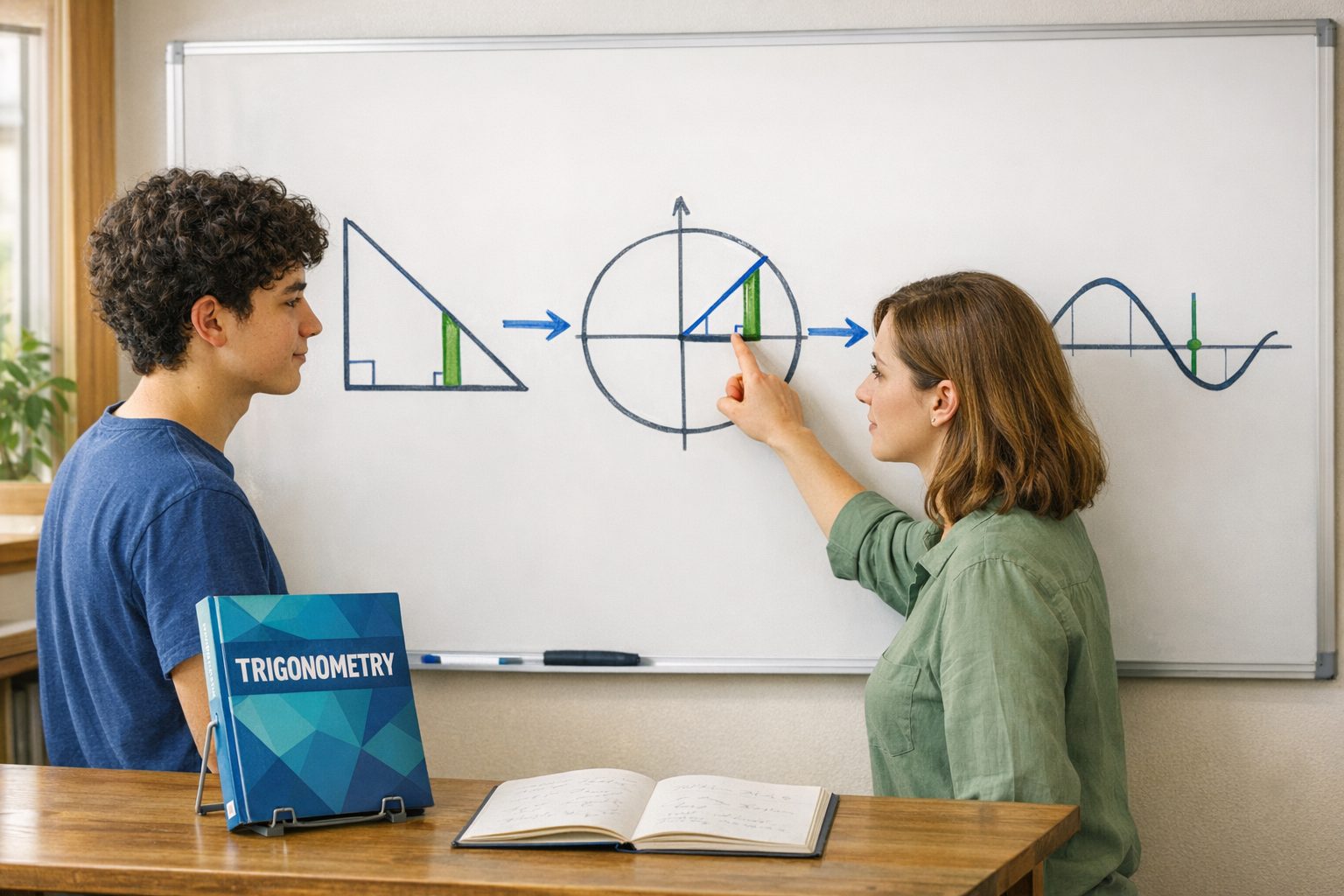
If you want to know how to understand trigonometry, I would start with the connections between the formulas, not a longer list to memorize. Trig is smaller than it looks when you can see how a triangle, a point on a circle, and a graph describe the same relationship.
That does not make every problem easy. But it gives you somewhere to start when a formula slips your mind. Let me show you the core ideas I would work on first.
How to Understand Trigonometry: Check the Foundation First
When a student hits a wall in trig, the gap may be further back: rusty algebra, uncertainty about functions, or difficulty with fractions and the Pythagorean theorem. Trig depends on those skills, so an older gap can make new material harder to learn.
Before tackling another page of trig problems, try this check: can you solve 3/5 = x/20? Can you find the missing leg of a right triangle when the hypotenuse is 5 and the other leg is 3? The answers are 12 and 4. If either process feels unfamiliar, review proportions or the Pythagorean theorem alongside your trig work.
If you are comfortable with the material, ask your student to explain each step rather than just checking the answer. If you are not sure where the reasoning breaks down, our trigonometry tutors at High Performance Tutoring can look through the work and ask questions to help distinguish a new trig concept from an older gap.
Core Idea #1: Sine, Cosine, and Tangent Begin with Ratios
For an acute angle in a right triangle, sine, cosine, and tangent are ratios of side lengths. Draw a right triangle, pick one of the non-right angles, and label the sides: the one across from your angle is the opposite, the side across from the right angle is the hypotenuse, and the remaining side is the adjacent.
The mnemonic soh-cah-toa is shorthand for these definitions:
- Sine = opposite / hypotenuse.
- Cosine = adjacent / hypotenuse.
- Tangent = opposite / adjacent.
For example, suppose the side opposite your chosen angle has length 3, the adjacent side has length 4, and the hypotenuse has length 5. Then sine is 3/5, cosine is 4/5, and tangent is 3/4. Choose the other acute angle and opposite and adjacent switch places. The hypotenuse does not change.
When you see sin(30°), you can ask: in a right triangle with a 30-degree angle, what is the ratio of the opposite side to the hypotenuse? It is always 1/2, no matter how large you draw the triangle. Triangles with the same angles are similar, so their corresponding side ratios match. The ratio depends on the angle, not the size.
Core Idea #2: The Unit Circle Extends the Triangle
The unit circle can look like a chart you are supposed to memorize. I would rather start with what the picture means. It connects angles to coordinates and extends sine and cosine beyond the acute angles in a right triangle.
Draw a circle with radius 1 centered at the origin. Start on the positive x-axis. Positive angles turn counterclockwise; negative angles turn clockwise. For an angle θ (theta), draw a ray from the origin until it meets the circle. That point has coordinates (cos θ, sin θ): cosine is the x-coordinate, and sine is the y-coordinate.
In the first quadrant, drop a vertical line from that point to the x-axis. You have a right triangle with hypotenuse 1. Its horizontal leg is cos θ and its vertical leg is sin θ. Those are the same ratios you just learned, with a denominator of 1.
The circle keeps going where the acute-angle triangle definitions stop. At 90°, the point is (0, 1), so cosine is 0 and sine is 1. At 180°, the point is (-1, 0), so cosine is -1 and sine is 0. You can also reason out signs: on the left half of the circle, x is negative, so cosine is negative.
Now imagine plotting the point's y-coordinate as the angle increases. It rises, falls, and repeats as you go around again. That is the connection between the circle and the sine graph.
One practical detail: angles can be measured in degrees or radians. A full turn is 360° or 2π radians, so 180° equals π radians. Before using a calculator, check that its angle mode matches the problem. A correct setup in the wrong mode gives the wrong answer.
Core Idea #3: Trig Identities Let You Rewrite Expressions
An identity is an equation that holds for every angle where both sides are defined. It gives you another way to write the same expression, which can make an equation easier to solve or a complicated expression easier to simplify.
A useful starting identity is sin² θ + cos² θ = 1. Here, sin² θ means (sin θ)². This identity comes directly from the Pythagorean theorem: a point on the unit circle has coordinates (cos θ, sin θ), and its distance from the origin is 1, so its squared coordinates add to 1.
Try rearranging it:
- Start with sin² θ + cos² θ = 1.
- Subtract cos² θ from both sides.
- You get sin² θ = 1 - cos² θ.
So if a problem contains 1 - cos² θ, you can replace it with sin² θ. You have not learned a separate fact. You have used algebra on a relationship you already understand.
Another useful relationship is tan θ = sin θ / cos θ, provided cos θ is not zero. That restriction matters: tangent is undefined wherever cosine is zero.
Not every identity follows from the Pythagorean theorem alone. Angle-sum formulas, for example, require additional reasoning. You will still need to learn the identities your course expects you to know. But understanding where they come from, and practicing when to use them, is more useful than treating each one as an unrelated line on a formula sheet.
Why Trig Is Worth Taking Seriously
Students ask me why they need any of this. Sine and cosine help model waves, rotation, and repeating behavior, including sound and alternating electrical current. They also appear throughout standard calculus courses. Comfort with trig leaves you more attention for learning what a derivative or integral actually means.
If you are preparing for calculus, practice moving between a trig expression, its graph, and the unit circle. The College Board's AP Precalculus course overview also includes trigonometric and polar functions among its units.
If your student is struggling, choose a narrow starting point: labeling sides, finding coordinates on the circle, or rewriting an expression. Have them explain why a step works, then try a similar problem without looking at the example. That gives you a better picture of understanding than asking, "Does this make sense?"
Even parents who remember the material may find that their teenager would rather work with someone else. A tutor offers a place to ask questions without a parent-child disagreement or an audience of classmates. If you already know your student will likely need help, I genuinely recommend setting up tutoring within the first two weeks rather than waiting until an exam is close.
Frequently Asked Questions
How can I understand trigonometry without memorizing everything?
Start with the side ratios, connect them to coordinates on the unit circle, and practice deriving simple identity rewrites. You will still need familiarity with common values and formulas, but these connections give the memorization a purpose. After studying an example, close your notes and explain why each step works.
What is the unit circle in simple terms?
It is a circle with radius 1 centered at the origin. Measure an angle from the positive x-axis, counterclockwise for a positive angle. Where its ray meets the circle, the x-coordinate is cosine and the y-coordinate is sine.
Why is trigonometry so hard for some students?
Sometimes the difficulty is an older gap in algebra or fractions. Sometimes the new challenge is connecting triangles, circles, and graphs. Avoid treating either as a permanent ability label. If the issue is rusty foundations, try saying, "You're out of practice with these skills. Let's find which ones need attention." If the concept is new, "You haven't learned this yet" is more accurate.
Do I really need trig for calculus?
For standard high school and college calculus sequences, yes. Review radians, the unit circle, trig graphs, and the identities your course uses. If those are unfamiliar, start reviewing before calculus begins rather than waiting until the week before a big exam.
If your student could use help with trig, reach out to High Performance Tutoring. Your first hour of tutoring is free, with no commitment, so your student can work with a tutor and you can see whether it works for your family before spending a dime.