When parents ask me about AP Calculus AB vs BC, I start with preparation, not ambition. How comfortable is your student with precalculus? How much room is there in next year's schedule? And how does their school teach each course? Those questions tell us more than whether a student thinks of themselves as a "math person."
Imagine a student who understands precalculus well but is already stretched by demanding classes and activities. AB might give her room to learn calculus without overloading her schedule. Another student with the same preparation and more time for math might prefer BC. Neither choice says anything permanent about their ability.
AP Calculus AB vs BC: What's actually different?
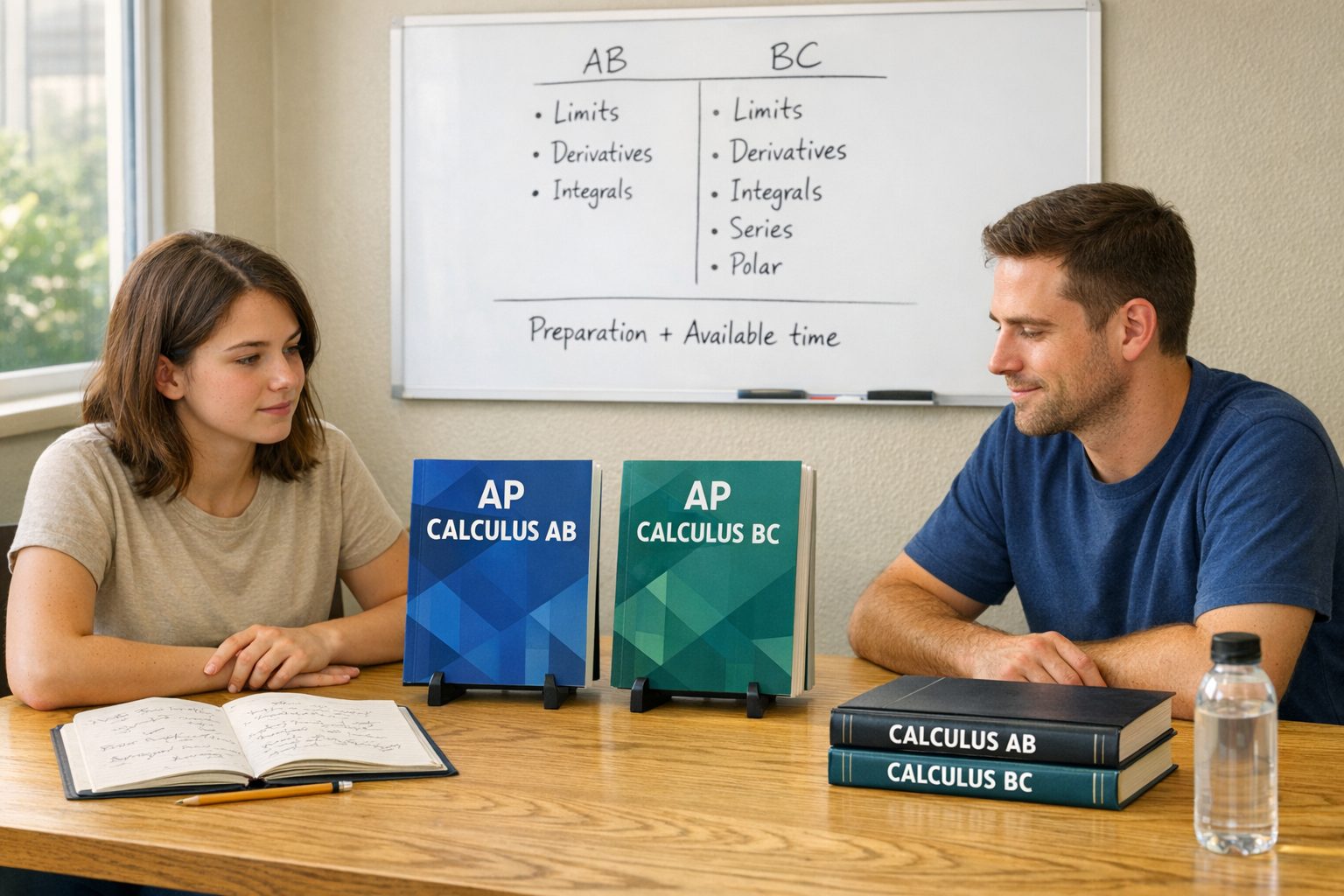
BC contains all the calculus topics in AB, then adds more. Both courses cover limits, derivatives, integrals, differential equations, and applications. The difference is the amount of material and, depending on the school's sequence, the pace.
AP Calculus AB is equivalent to a first-semester college calculus course. When taught over a full school year, its narrower scope can allow more time to practice and absorb the fundamentals. That does not make it an easy class.
AP Calculus BC is equivalent to first- and second-semester college calculus. It includes all of AB plus topics such as infinite sequences and series, calculus with parametric, polar, and vector-valued functions, and additional integration techniques.
If both courses start after precalculus and run for the same school year, BC has more ground to cover. If your school requires AB before BC, the pacing will be different. Ask about the actual sequence rather than judging by the course name alone.
You can compare the official topic lists in College Board's AP Calculus AB and AP Calculus BC descriptions.
Is AP Calculus BC really that much harder?
BC asks students to learn more calculus, including concepts that can be challenging in their own right. Series, for example, introduce questions about infinite sums that do not appear in AB. The challenge is not just speed, though speed matters when BC follows precalculus directly.
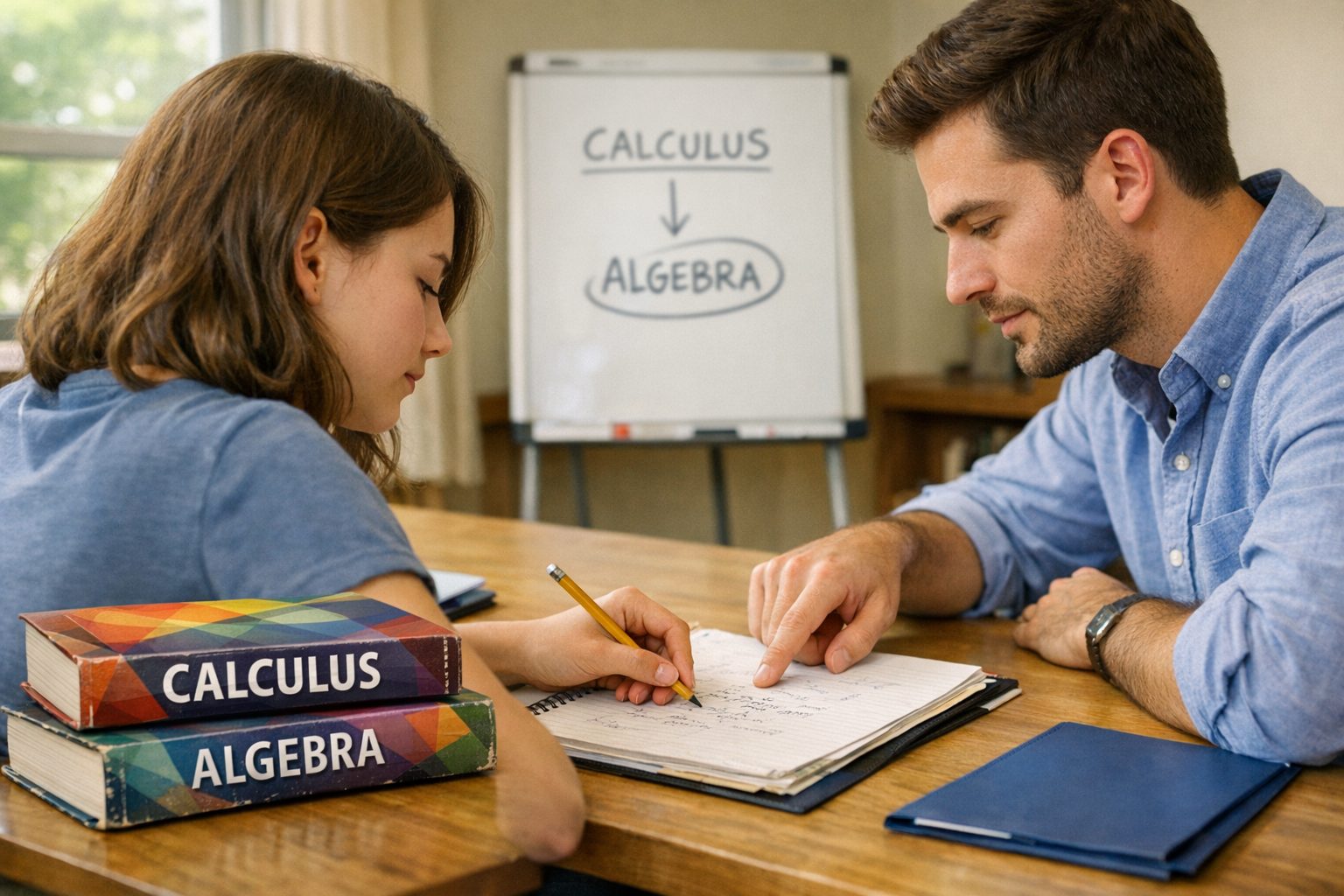
The foundation I would check first is algebra, functions, and trigonometry. A student who has to stop repeatedly to rearrange an equation or recall a trig identity has less attention available for the new calculus idea. That matters in either course, and a faster pace gives the student less time to catch up.
If your child describes this as a fixed limitation, give them a more useful phrase: "You're out of practice with some of the prerequisites. Let's find which ones." That turns a judgment about ability into a task you can work on.
AB is not a substitute for precalculus readiness. If the gaps are substantial, talk with the math teacher about whether more preparation is needed before either course.
What about college credit?
For a lot of families, credit is the reason they are asking, so it is worth separating course content from college policy.
An accepted AB exam score may earn credit or placement for first-semester calculus. An accepted BC exam score may earn credit or placement for first- and second-semester calculus. Neither outcome is automatic, and placement into a higher course is not always the same as receiving credit toward graduation.
The BC exam also reports an AB subscore, based on performance on the AB portion of the exam. Some colleges use that subscore to award first-semester credit or placement even when the overall BC score does not qualify for the full BC award. Treat it as a possibility to check, not a guaranteed safety net.
Before choosing based on credit, look up each likely college's current AP policy and the intended department's requirements. Check:
- Which exam scores qualify, and which courses they replace.
- Whether the college accepts the BC exam's AB subscore.
- Whether the award is credit, placement, or both.
- Whether that credit satisfies the student's intended major requirements.
If a policy is unclear, ask the registrar or academic department. Even accepted credit does not necessarily shorten a degree or reduce tuition.
Who should consider BC, and who should choose AB?
I would lean toward BC if your student has a well-practiced precalculus foundation, wants to study more calculus, and has room in their schedule for the workload. Interest in a math-intensive college major is another reason to consider it, but it does not make BC mandatory.
I would lean toward AB if your student is ready for calculus but would benefit from more practice time, is balancing demanding courses or other responsibilities, or prefers to focus on a smaller set of topics. AB is a substantial calculus course, not a consolation prize.
Before deciding, I would ask the current math teacher about readiness and the prospective calculus teacher about workload. Find out whether BC assumes prior AB knowledge, how quickly it starts, and what preparation the teacher recommends.
My priority is understanding. I would rather see a student learn AB thoroughly than choose BC solely for the label and spend the year trying to keep up. But uncertainty alone is not a reason to rule out BC. Get specific about what is causing it.
How can you check calculus readiness?
Ask the precalculus teacher for a readiness review aligned with your school's calculus courses. As a starting point, have your student try tasks such as these without notes:
- Simplify a rational expression and identify excluded values.
- Solve an exponential or logarithmic equation and explain the steps.
- Use the unit circle to evaluate a trig function and apply a basic trig identity.
- Interpret a function's graph, domain, and transformations.
This is not a speed contest. Ask your student to explain their reasoning. A forgotten fact that comes back with a brief review is different from a concept they cannot explain even after a prompt. Use that distinction to plan practice, not to assign a label.
If you remember the material, you can help review the work. If you do not, ask the teacher for guidance rather than trying to diagnose everything yourself.
How tutoring supports either track
At High Performance Tutoring, our calculus tutors can work through problems with your student, ask them to explain each step, and help distinguish a calculus misunderstanding from an algebra or trig gap. Sometimes help also lands better from someone other than mom or dad, with room to ask questions privately.
If your student is unsure whether a tutor would help, the first hour is free, with no commitment. Bring recent work and the school's readiness review so the session addresses a concrete concern.
I genuinely recommend starting early if you already expect to need help. Use the summer for manageable prerequisite practice, or arrange tutoring within the first two weeks of a demanding course. Don't wait until several new topics depend on something your student never understood.
Frequently asked questions
Can a student take AB first and then BC?
Yes. Some schools use that sequence; others allow prepared students to enter BC directly from precalculus. AB is not a universal prerequisite for BC. Ask how your school handles the overlapping material and what course would follow AB or BC in the student's remaining high school years.
Does taking BC instead of AB look better to colleges?
BC covers more material and can demonstrate additional course rigor. But there is no universal rule that a particular AB grade or exam score "beats" a particular BC result. Colleges evaluate coursework and performance in context, including what the high school offers. An AP exam score is also different from the grade earned throughout the course. Choose a meaningful challenge, not a label you hope will settle an admissions decision.
My child is out of practice in math. Is calculus off the table?
Not necessarily. Identify the gaps with the teacher, then make a realistic plan to address them before the course begins. A light summer routine with targeted practice can be useful. If major prerequisites are still missing, discuss the course sequence rather than assuming AB will solve the problem by moving more slowly.
Still not sure whether AB or BC is the right fit? Reach out to High Performance Tutoring to review your student's foundations with a calculus tutor and plan the next step. Your first hour of tutoring is free.