If you want to know how to study for chemistry, start with this question: can you solve a problem with your notes closed? Picture a student who spends the night before a test rereading the textbook. The examples look familiar, so she feels ready. Then the test asks her to set up a calculation on a blank page, and she does not know where to begin. The effort was real. The practice did not match the task.
Chemistry involves vocabulary, but knowing definitions is not enough. A test may ask you to balance an equation, use a mole ratio, or identify a limiting reactant. You can know the definition of "stoichiometry" perfectly and still have trouble solving a stoichiometry problem. Reading can help you understand an explanation. Working problems shows you whether you can use it.
Here is the study routine I recommend.
Why Chemistry Is Hard to Cram
Chemistry builds on earlier ideas. Stoichiometry depends on understanding moles and balanced equations. Gas-law calculations call on algebra, units, and the relationships among pressure, volume, temperature, and amount of gas. If unit conversions are shaky, a new chapter can feel confusing even when the new concept makes sense.
Spreading practice across several days gives you chances to discover those gaps, ask questions, and try again. A last-minute session can still help, but it leaves little room to fix something you do not understand. I would rather a student find that problem early in the week than late the night before the test.
How to Study for Chemistry: A Practical Routine
1. Work problems before checking your notes. Rereading and highlighting can feel productive because the material looks familiar. But recognizing a solution is different from producing one. Redo a worksheet without looking at your old answers, or try an old quiz with the solutions covered. Write down what is given, what you need to find, and why your first step makes sense.
When you get stuck, identify the specific obstacle. Do you not know which relationship to use? Can you set up the equation but not rearrange it? Did you lose track of the units? Check the relevant explanation, finish the problem, and then try a similar problem without help. Copying the solution is not the finish line.
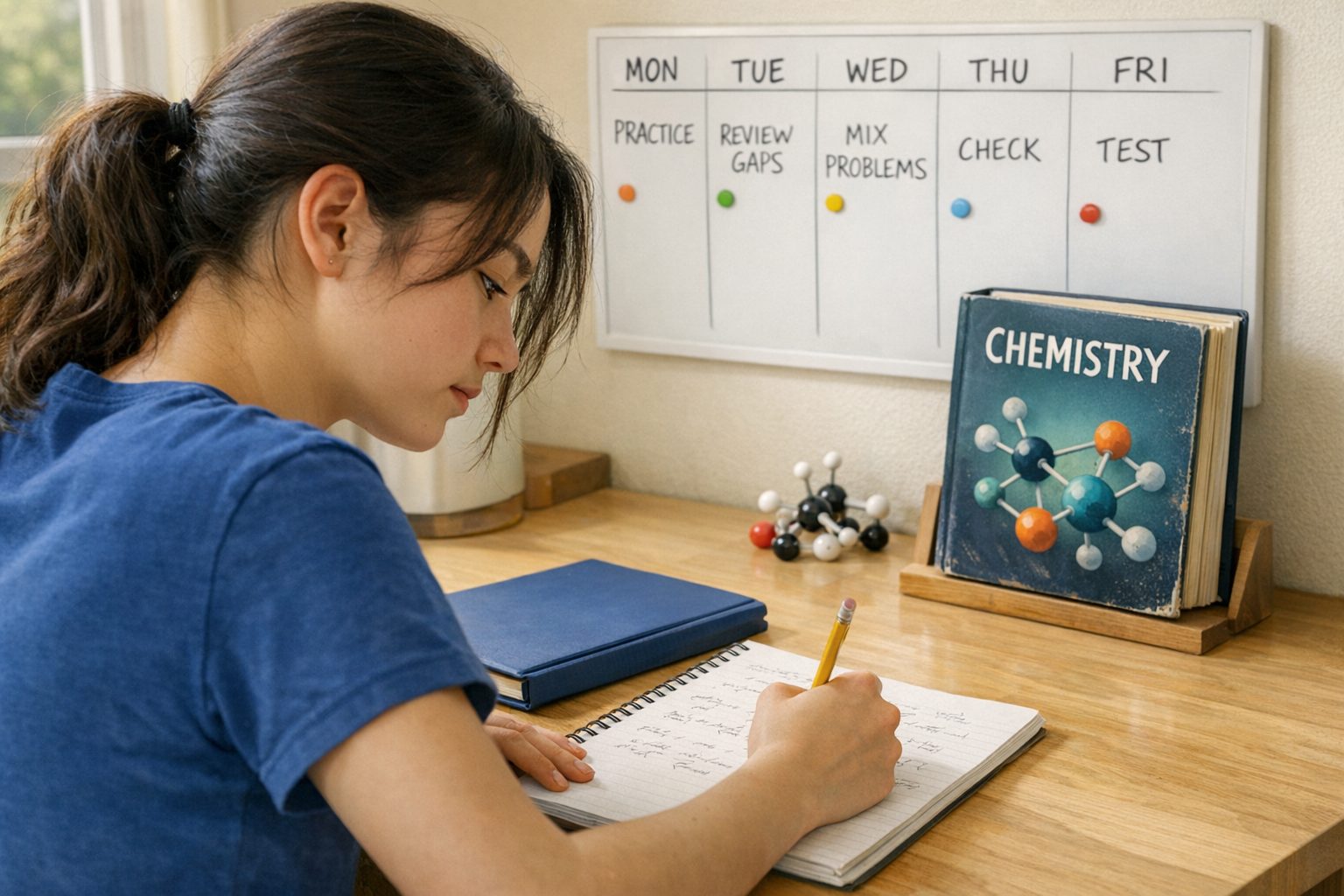
2. Spread the work across the week. For a Friday test, a workable plan is to try representative problems Monday, review the gaps Tuesday, mix problem types Wednesday, and do a short closed-notes check Thursday. These are suggested study sessions, not a formula for a guaranteed grade. Adjust the time to the material and how much help you need.
Keep a short error list as you go: "used grams where the equation needed moles," "forgot to convert to kelvin," or "used the wrong coefficients." On the next study day, start with a fresh problem that tests one of those mistakes. The goal is to find out whether you can now make the decision correctly, not whether you remember yesterday's answer.
3. Find the foundations your current unit uses. Use your teacher's study guide, homework, and recent quizzes rather than guessing what matters. For stoichiometry, check moles, molar mass, and balanced equations. For gas laws, check the relationships in PV = nRT and the required units. For acids and bases, the foundation might be concentration, equilibrium, or logarithms for pH calculations, depending on what your class has covered.
A useful stoichiometry check is whether you can explain the route from grams of one substance to grams of another: convert to moles, use the balanced equation's mole ratio, then convert to grams. If you cannot explain one of those steps, review it before tackling a more complicated problem.
4. Make the math visible. Scientific notation, unit conversions, and rearranging equations can become obstacles even when you understand the chemistry. Write the setup and carry the units through the calculation. Use a calculator when your teacher allows it, but do not let the calculator hide your reasoning. Practice entering scientific notation and using parentheses correctly, too.
If the algebra is the sticking point, practice that separately before returning to the chemistry problem. Check whether your final units match what the question asks for and whether the size of the answer makes sense.
5. Explain a hard problem out loud. After solving a problem, explain why each step is necessary. A sibling, parent, or empty room will do. If you reach a step and can only say "and then you just do this," you have found something to investigate. Follow the explanation with a different problem to check whether you can apply the same idea without relying on the original example.
A Note on AP Chemistry
AP Chemistry requires conceptual understanding as well as calculations. The free-response questions ask students to explain and justify answers, so practice writing the reasoning, not just finding the number.
My recommendation is to use College Board's released AP Chemistry free-response questions and scoring guidelines throughout the course. Choose questions or question parts that match topics you have already learned. Save full exam practice for when you have covered enough of the course.
Try a question before opening the scoring guidelines. Then compare your work with the criteria: did you identify the relevant chemistry, support the conclusion, and show the required calculation? Rewrite an incomplete explanation in your own words, then return to that topic with a fresh question. Keep using your class assignments as well; free-response practice does not replace the rest of the course.
When to Bring in Help
If you are comfortable with the material, ask your child to talk through a problem while you listen. You may spot the exact point where the reasoning breaks down. If chemistry is no longer familiar, there is no shame in that. And even a parent who knows the subject may find that a teenager is more willing to ask questions with someone else.
Keep the language specific and changeable. Try "You're out of practice with unit conversions, so let's work on those," rather than turning a difficult chapter into a judgment about ability.
At High Performance Tutoring, our chemistry tutors can work through a student's calculations and ask questions about each step to help identify the missing foundation. It may come from the current unit, an earlier chemistry topic, or a previous math class. One-on-one help also gives the student room to admit confusion without classmates listening.
If your child already expects chemistry to be difficult and likely needs help, I recommend setting up tutoring in the first two weeks rather than waiting for a crisis. If your child is hesitant, the first hour is free with no commitment, so you can both see whether the tutor's approach works for you. Results are not guaranteed; the student's practice between sessions matters.
Frequently Asked Questions
How many days before a chemistry test should I start studying?
Practice as the unit progresses, then begin focused test review several days ahead. A Monday start for a Friday test is a useful planning example, not a minimum that works for everyone. If your first practice session reveals missing foundations, seek help then rather than waiting until the night before.
Why do I understand chemistry in class but freeze on the test?
Following a teacher's solution is different from choosing the steps yourself. Try a similar problem alone with your notes closed. If you can do it untimed but struggle during tests, timing or anxiety may also be contributing. Discuss that pattern with your teacher instead of assuming more rereading will fix it.
Is chemistry harder than algebra?
There is no single answer. Chemistry uses algebra while also asking you to interpret chemical ideas and units. If you are out of practice with algebra, reviewing equation rearrangement and scientific notation can remove an obstacle. If the math is fine but you cannot choose an equation, focus on the chemistry behind the setup.
How do I pass a chemistry class I'm already behind in?
Talk with your teacher about upcoming assessments, missing work, and which foundations you need next. Bring a recent quiz or assignment and ask where your reasoning first went off track. Review those gaps while keeping up with current work as best you can; do not assume you need to reteach yourself the entire course before moving forward.
If chemistry has your student stuck, we'd love to help. Your first hour of tutoring is free, with no commitment. Reach out to High Performance Tutoring to meet a chemistry tutor and see whether the approach works for your student.