If you want to know how to get better at physics, start with the problem you couldn't solve even though you knew the formula. That's the gap I want to look at: not whether you remembered the equation, but whether you knew when and why to use it.
Memorizing formulas can help, but it isn't enough. A useful study session should leave you able to explain what's happening, choose an equation that fits, and work through the math without a solution beside you. Let me show you what that looks like.
Why Does Physics Feel So Hard?
Physics asks you to apply familiar ideas to unfamiliar situations: a block on a ramp, a ball thrown off a cliff, a car braking on a wet road. Remembering an equation doesn't tell you whether it applies. You also need to recognize the physical principle and its assumptions. For example, an equation that assumes constant acceleration may not work when acceleration changes.
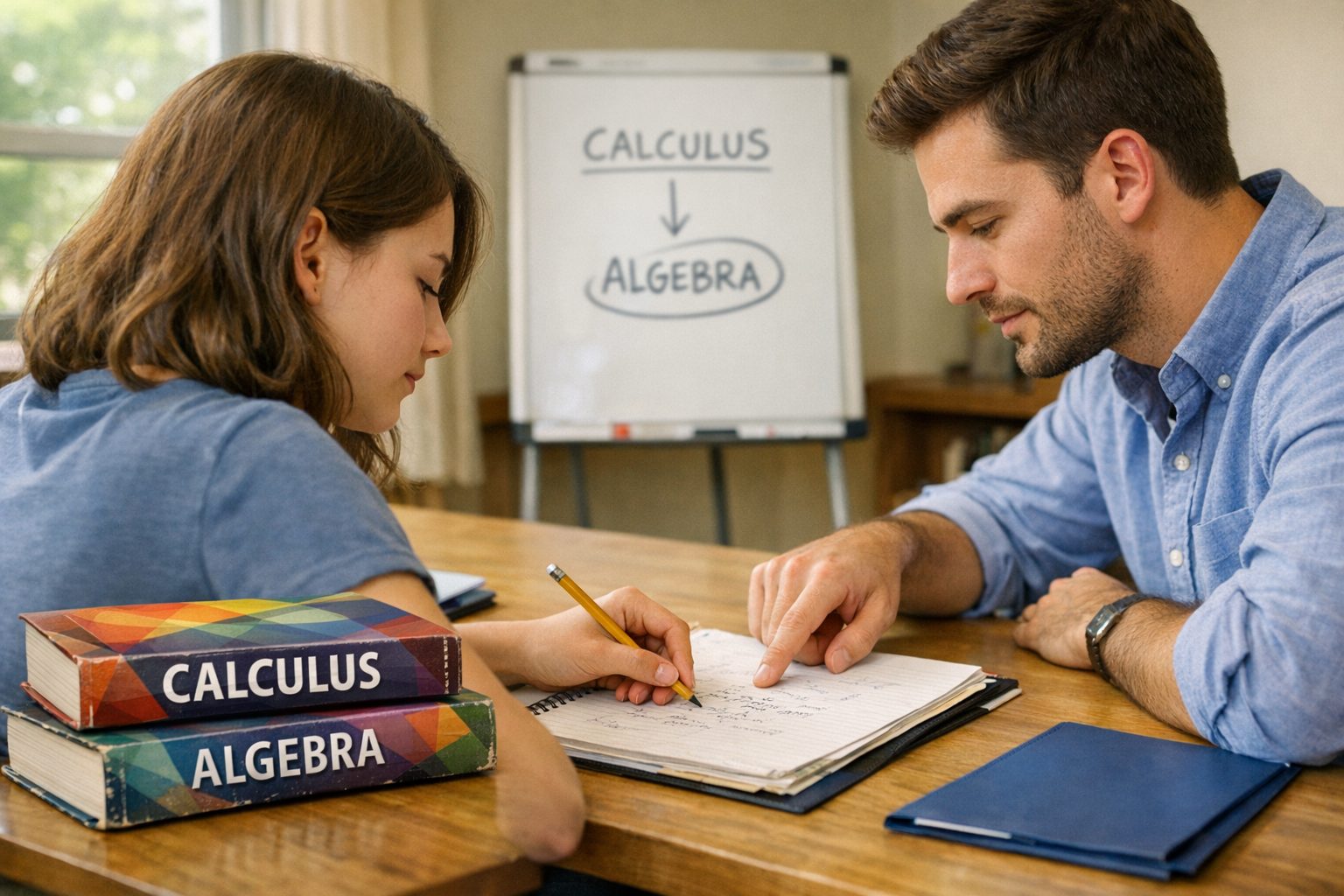
The math can add another layer. Introductory physics relies on algebra, and many courses also use trigonometry. If you're out of practice at rearranging equations or using sine and cosine, a physics problem becomes a conceptual task and a math task at the same time.
For parents, I'd replace a fixed ability label with something specific: “You're out of practice at the algebra this problem needs. Let's work on that step.” That gives your student something to do rather than a verdict about what they can learn. Math isn't always the obstacle, but it's worth checking.
How to Get Better at Physics: Understand First, Then Practice
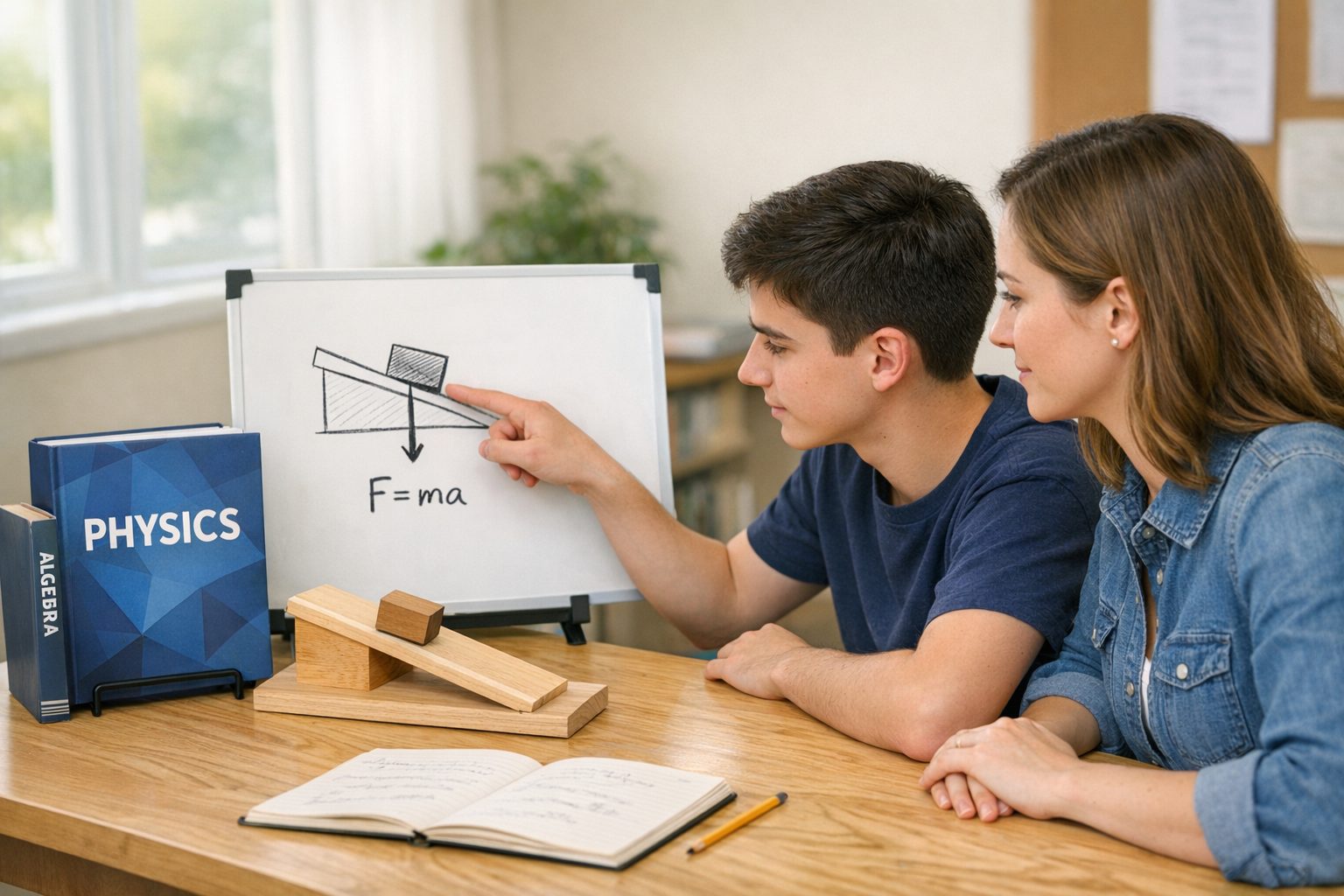
Learn the meaning and limits of each equation. Take F = ma. Here, F means the net force: all the forces on the object added together with their directions accounted for. Acceleration means a change in velocity, which can involve speeding up, slowing down, or changing direction. For the same mass, a larger net force produces a larger acceleration. For a larger mass, you need more net force to produce the same acceleration. Before using an equation, explain what its quantities mean and when it applies.
Read the problem before you reach for a formula. Don't just scan for numbers and matching letters. Ask: what is physically happening? What am I being asked to find? Is the object accelerating, or is its velocity constant? Write down what you know and what you need. That pause can prevent you from solving the wrong problem very accurately.
Draw a picture that serves the problem. For a motion problem, sketch the situation and label directions, positions, and velocities as needed. For a force problem, make a separate free-body diagram: isolate the object and draw the external forces acting on it. Don't add velocity as though it were a force. Choose a positive direction and keep it consistent through the equations.
Track your units like they're money. Units are a built-in error checker. If you're solving for speed and your answer has units of seconds, something went wrong. Carry units through the calculation and convert incompatible units before combining them. Correct units don't prove the answer is right, though. Also ask whether its size and direction make sense.
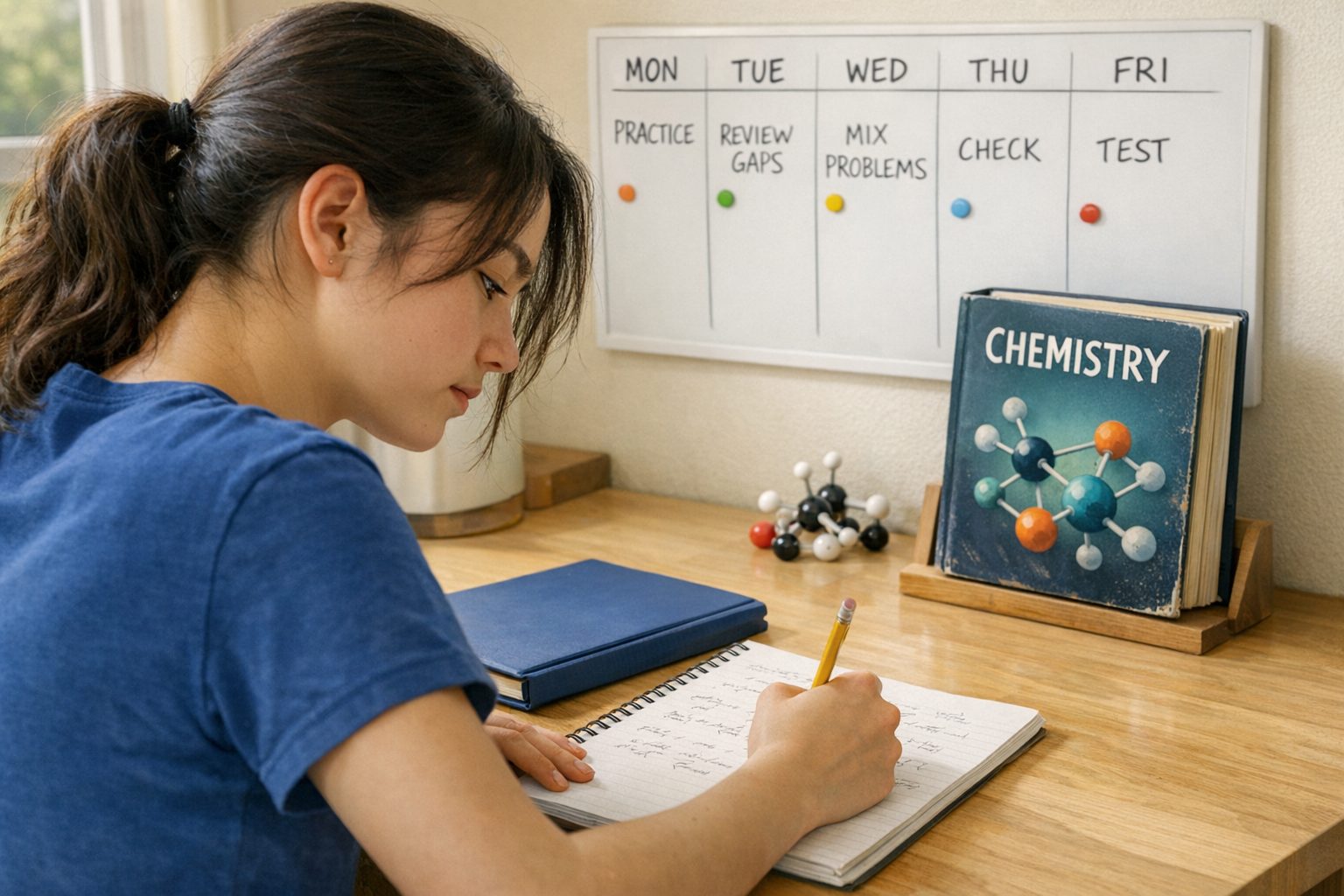
Rework missed problems, then try unfamiliar ones. Find the first step where your reasoning went off track. Was it the diagram, the choice of equation, or the algebra? Review that step, put the solution away, and redo the problem from a blank page. Then try a different problem using the same idea. That checks whether you learned the method rather than remembered the solution.
Shore Up the Math Underneath
If physics feels overwhelming, separate the setup from the calculation. Try rearranging v = v₀ + at to solve for a without numbers. You should get a = (v − v₀)/t, provided t is not zero. If that step is difficult, practice rearranging equations before adding the physics back in.
If your course uses vectors, check whether you can break a force into horizontal and vertical components. Draw the angle first. When the angle is measured from the horizontal, the horizontal component uses cosine and the vertical component uses sine. Changing where the angle is measured changes that assignment, so don't memorize it without the picture.
For an illustrative example, picture a student who can explain why a cart accelerates but gets stuck isolating acceleration in an equation. More explanation of forces may not address that obstacle. After practicing the algebra, the student can return to the cart problem and work through it more independently. That's the kind of distinction I want a student to make before deciding they need to relearn the whole chapter.
If you'd like to review the foundations, start with our advice on getting better at algebra. If you can work through your student's reasoning together, do. If the material isn't familiar, or homework help keeps turning into an argument, you don't have to be the teacher.
At High Performance Tutoring, our physics tutors can review a student's work and ask them to explain each step, helping distinguish a conceptual gap from a math mistake. It can also help to work with someone who isn't a parent and to ask questions without classmates watching. If your student is unsure about tutoring, the first hour is free with no commitment, so they can try working with a tutor before you spend money.
A Note on AP Physics
AP Physics courses and exams ask students to apply concepts, interpret representations, and justify answers, not just recall equations. Use the course description and sample questions for your particular course on the College Board's AP Students site.
My advice is to practice written explanations alongside calculations. Before substituting numbers, state why the equation applies. Afterward, explain what the answer means in the situation. For free-response practice, compare your work with the official scoring guidelines: did you include the reasoning the question requested, or only the final number?
Frequently Asked Questions
Why do I understand physics in class but freeze on the test?
Following a worked example is different from choosing a method independently. Try a problem without looking at your notes and notice where you stop. If you can't choose an approach, practice identifying the relevant principle. If you can solve it untimed but struggle during tests, look at pacing and anxiety too. Bring that observation to your teacher rather than assuming more formulas will solve it.
Do I really not need to memorize formulas?
You need to know what the formulas mean and use them fluently. Check which reference materials your teacher or exam permits. Even when an equation sheet is available, it won't tell you which equation fits or what assumptions it requires. Practice with the materials you'll actually have on the test.
Is physics or the math the real problem for me?
Take a missed problem and separate it into stages: interpreting the situation, choosing a principle, setting up an equation, and calculating. A correct setup followed by an algebra slip points toward math practice. Trouble choosing a principle suggests conceptual work. Setup errors can involve either, so ask your teacher to check your reasoning if you can't tell.
When should I get physics help if I'm falling behind?
Don't wait until the day before the exam. Bring an unresolved problem to your teacher or a tutor while you're still working on that topic. We recommend starting tutoring early: if you already expect to need help in a tough class, set it up in the first couple of weeks rather than waiting for a disappointing test.
For your next study session, pick a missed problem. Sketch it, explain the principle, solve it without the answer beside you, and check the result. That gives you something more useful than another read-through of your notes: a clear view of what you understand and what needs work next.
If physics has your student feeling stuck, High Performance Tutoring can help them work on the concepts, math, and study habits behind the difficulty. Your first hour of tutoring is free, with no commitment, so you can decide whether the approach works for your student. Learn more about our physics tutors or reach out to get started.