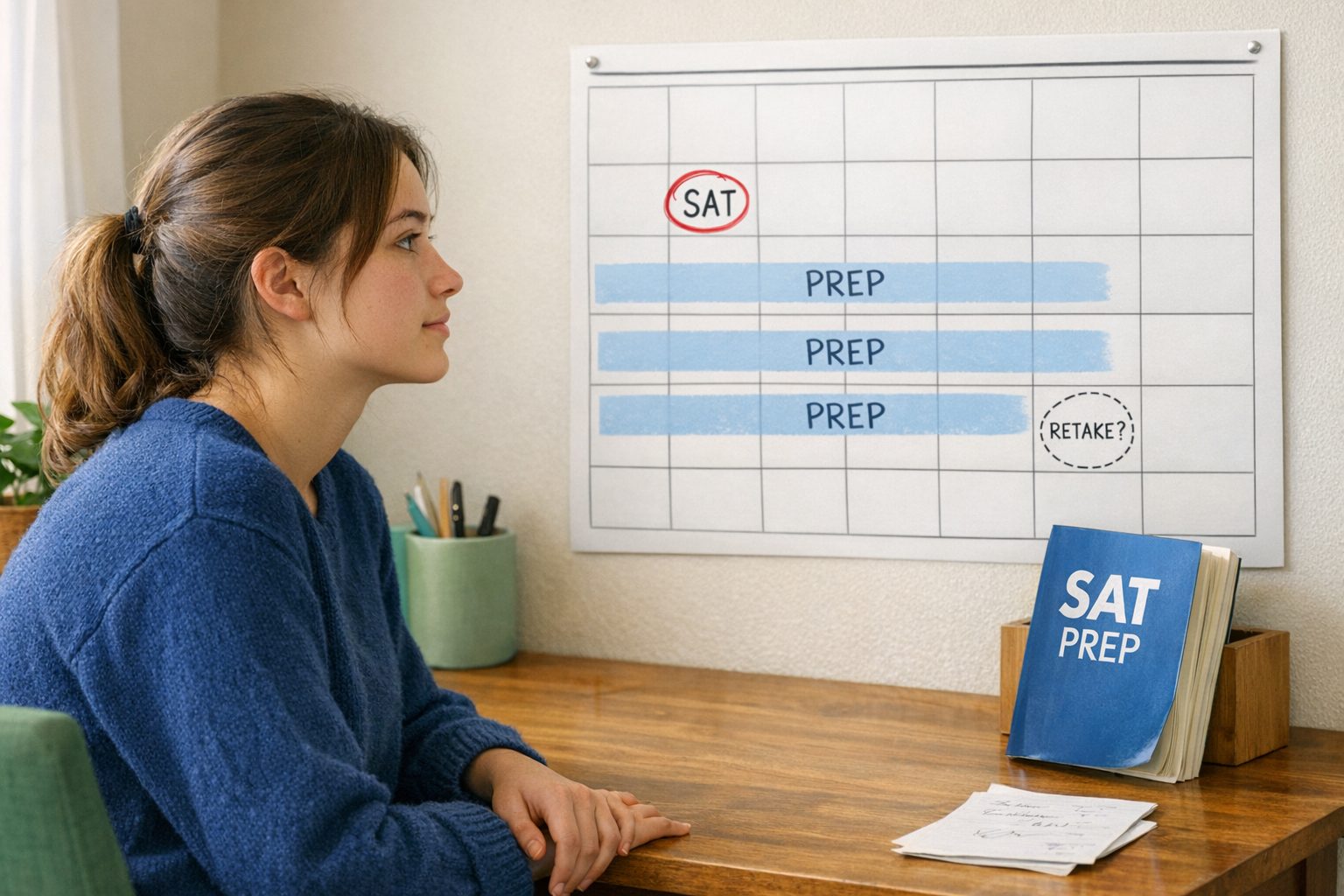
How many times should you take the SAT or ACT? My usual recommendation is to leave room for two or three sittings, with real preparation in between. That is a planning guideline, not a requirement. If your first score does what you need it to do, stop. If you are considering another attempt, the important question is what will change before test day.
Consider an illustrative example: a senior keeps retaking the ACT, hoping the next test will feel easier. Her scores stay in roughly the same range, and her family is exhausted. Instead of registering again immediately, she works on reading pacing and the math topics she has been avoiding. With that preparation, her score could improve. The point is not that another attempt fixes the problem. It is that another attempt needs a different plan.
How Many Times Should You Take the SAT or ACT? Start With a Plan
I would not use a paid, official sitting just to establish a baseline. Start with a full-length official practice test under realistic timing conditions. For the digital SAT, use Bluebook. For the ACT, make sure the practice test matches the current enhanced format.
Your first official sitting should come after preparation. It gives you a score you can use and experience with the actual testing environment. A second attempt can make sense if you have identified specific skills or pacing problems to work on.
A third sitting is optional. I would consider it when a student is still short of a meaningful target and practice results suggest that further improvement is realistic. Beyond that, I want a stronger reason than "maybe this time." There is no universal attempt number at which improvement stops, but there is a point when the cost in time and energy outweighs the likely benefit.
How Superscoring Changes the SAT Retake Math
Superscoring can make a retake more useful. When a college superscores the SAT, it combines your highest Math score and your highest Verbal score from eligible test dates, even if they came from different sittings. College Board officially calls the Verbal section Reading and Writing.
For the current enhanced ACT, the Composite uses English, Math, and Reading. The ACT superscore likewise uses the highest eligible scores in those three subjects across test dates. Optional Science is reported separately and does not enter that Composite calculation. Colleges set their own policies for accepting superscores and considering Science.
This changes how a student can approach preparation. If your daughter's Math score is already strong but Verbal lagged, her next round of preparation can lean more heavily on Verbal while keeping Math skills fresh. A gain there may raise her SAT superscore even if Math dips a little.
The College Board and ACT websites explain score reporting. Before registering, also check each college's admissions page for its current superscoring rules, required score reports, and latest accepted test date. Not every college superscores, and some require all scores from a particular test.
A Simple Decision Framework for Your Next Attempt
After each sitting, sit down together and walk through these questions. A retake should have a purpose beyond replacing a disappointing morning.
Is the score below a meaningful target? Look up the middle 50% score range published by each college, and check which entering class it describes. Those ranges describe a group of students, not an admissions cutoff. At test-optional colleges, they may reflect only students who submitted scores. A score below the range is a reason to consider more preparation, not proof that admission is out of reach. A score above it does not guarantee admission either.
Scholarships can give you a more concrete target. Check whether a particular award has a published test-score requirement, whether meeting it guarantees consideration or an award, and which testing deadline applies. Do not assume every merit scholarship has a score cutoff.
Are practice scores consistently higher than the official score? That can support a retake, especially if you can identify a test-day problem. Use fresh, full-length official practice tests with the correct timing, breaks, and accommodations. Familiar questions or generous timing can make practice scores look more reassuring than they should. Even realistic practice results are evidence, not a promise.
Is one section holding the score down? A section score gives you a starting point, but it does not tell you exactly what to fix. Review missed and guessed questions from practice. Separate gaps in knowledge from misreading, pacing problems, and calculation errors. Then choose practice that addresses the recurring problem rather than reviewing everything equally.
Will something actually change before the next test? If the plan is "try harder" or "hope for a better day," I would wait. A useful plan names the skill, the practice, and the way you will check progress. For example: review linear equations, explain each missed solution, then try unfamiliar questions under timed conditions.
What will it cost in other areas? Registration fees matter, but so do grades, essays, activities, and sleep. A senior retaking the SAT while writing applications and carrying a heavy course load needs to be honest about whether the preparation time is available. Protecting schoolwork may be the better choice.
When to Stop Retaking the SAT or ACT
I tell families to consider stopping when the score meets their admissions and scholarship goals, when focused preparation is no longer producing progress, or when another attempt would crowd out more important work. After several well-prepared attempts with flat results, I would pause and reassess rather than register automatically.
A plateau is not a verdict on a student's ability. Parents can replace "You're just not a test person" with "You may be out of practice with this skill. Let's look at where you're getting stuck." That gives the student something specific to work on without making the score part of their identity.
It is also fine to decide that more improvement is not worth the time right now. You do not have to reach your highest imaginable score before you are allowed to stop.
Plan the Timeline So Retakes Are Possible
I like families to begin planning before junior year gets crowded. If the student is ready, a first official sitting during junior year can leave room for further preparation and a later attempt without pushing everything into application season. Readiness matters more than following someone else's calendar.
Work backward from each college's latest accepted test date and any scholarship deadlines. Leave time to review results, practice, and check progress before the next sitting. Check official registration deadlines too. A seat on the calendar is not a substitute for preparation.
If you know the material, you can help your student review errors by asking, "What made you choose that answer?" and "How would you recognize this problem next time?" If the explanation is outside your comfort zone, or your teenager would rather work with someone other than a parent, that is a reasonable place to bring in help.
At High Performance Tutoring, a tutor can work through those questions with your student and help turn recurring errors into a preparation plan. Our SAT prep course and ACT prep course are options for families who want that support. Score gains are never guaranteed; effort between sessions is the biggest factor. If your student is unsure whether a tutor would help, the first hour is free, with no commitment, so they can see whether the approach works for them.
Frequently Asked Questions
How many times should you take the SAT?
I recommend leaving room for two or three sittings, not committing to all of them. Stop after one if the score meets your goals. Retake only when you have a reason to improve it and a specific preparation plan.
Do colleges care if you take the SAT or ACT many times?
There is no universal admissions rule about attempt counts. Check which scores each college requires and whether it superscores. Do not assume that taking the test repeatedly either demonstrates persistence or harms your application.
Should I retake the ACT if I got a decent score?
Define "decent" against your own goals. Another attempt may be worthwhile if it could strengthen an application or meet a published scholarship requirement, and your preparation supports that possibility. Otherwise, grades and applications may deserve the time more.
How long should you wait between SAT attempts?
Long enough to make and test a meaningful change in your preparation. Before registering, identify what you will work on and when you will complete a fresh timed practice test to check progress. Back-to-back sittings leave less room to do that work.
Is it better to switch from the SAT to the ACT instead of retaking?
Sometimes. Try official practice tests in the current formats and compare the results using official SAT-ACT concordance guidance, not raw scores. Also consider pacing and which format feels more manageable. Switching creates its own preparation work, so weigh that against continuing with a test you already know. My SAT or ACT guide can help you think through the choice.
If your student is deciding whether another attempt is worth it, reach out to High Performance Tutoring and we will help you think through a plan. Your first hour of tutoring is free, with no commitment.