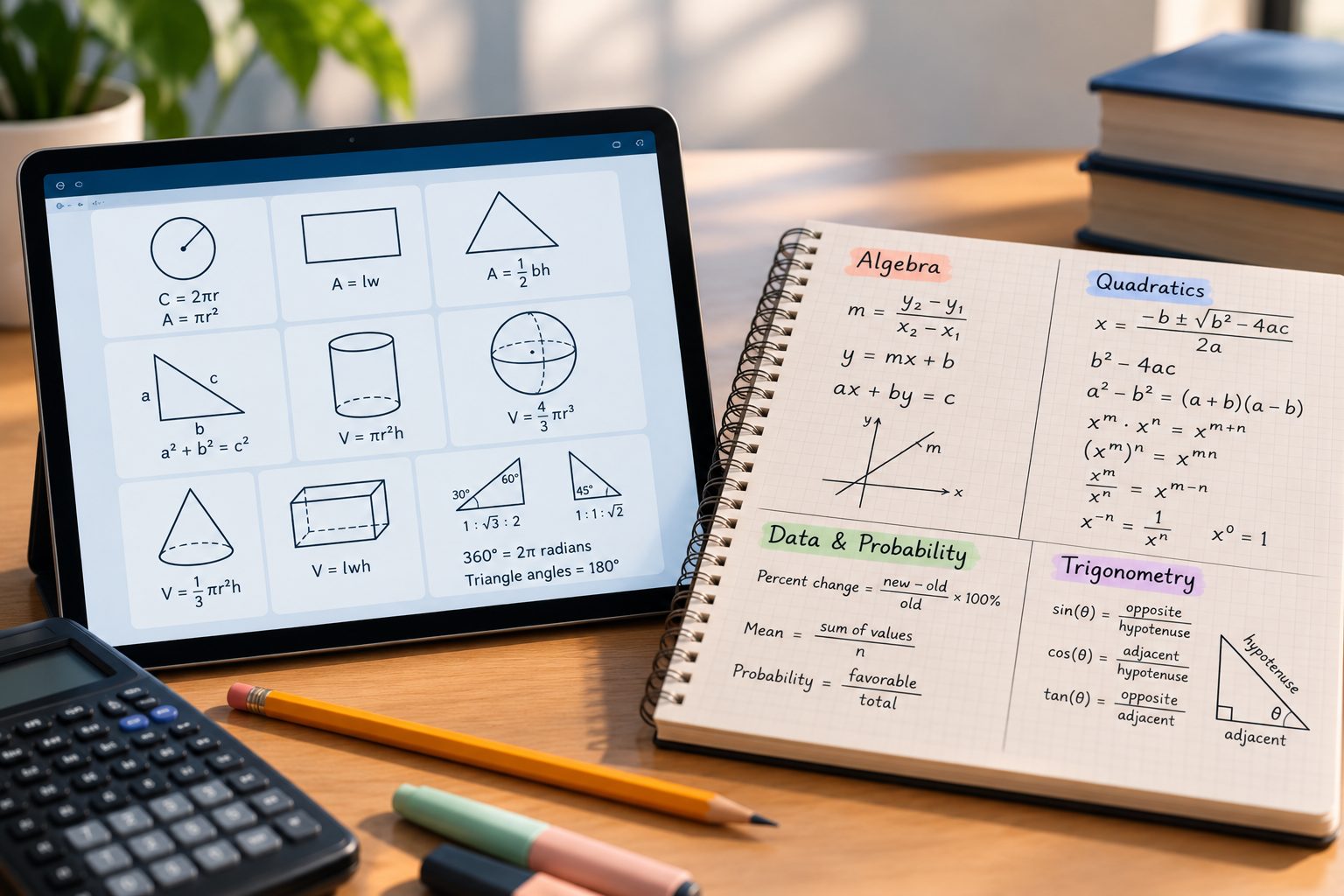
The digital SAT gives you a formula sheet, but it leaves out slope, the quadratic formula, and basic trig ratios. When I help students study SAT math formulas, that is where I start: separate what Bluebook provides from what you need to know without it.
Memorizing the area of a circle while never practicing slope is not a good use of study time. Here is how I would organize your review, using the four content domains in the College Board's digital SAT. This is a focused formula guide, not a complete list of everything the Math section tests.
SAT Math Formulas Bluebook Already Gives You
The reference sheet in the Bluebook app includes area and circumference of a circle, area of a rectangle and a triangle, the Pythagorean theorem, volume formulas for a rectangular prism, cylinder, sphere, cone, and rectangular pyramid, and the special right triangle ratios for 30-60-90 and 45-45-90 triangles. It also reminds you that a circle has 360 degrees and 2π radians, and that a triangle's angles sum to 180 degrees.
Does that mean you can ignore these? Not quite. Knowing a formula is on the sheet is different from knowing when and how to use it. Practice locating the formulas and identifying what each variable represents. For a cylinder, for example, you need the radius, not the diameter, before substituting into the volume formula.
The sheet is your safety net, not your study plan. The built-in Desmos calculator is also available throughout the Math section, but you still have to decide what to enter.
Domain 1: Algebra
The reference sheet offers little help with algebra. These relationships are worth knowing without looking them up.
Slope of a line. Slope equals the change in y over the change in x: m = (y2 − y1) / (x2 − x1). The labels x1 and y1 belong to the first point; x2 and y2 belong to the second. For points (1, 3) and (4, 9), the slope is (9 − 3) / (4 − 1) = 2. If the x-coordinates are equal, the line is vertical and its slope is undefined.
Slope-intercept form. y = mx + b, where m is the slope and b is the y-intercept. In a linear model, b is the value of y when x = 0, and m is the change in y for each unit increase in x. Practice identifying both from a word problem, including their units.
Standard form and intercepts. For ax + by = c, set y = 0 to find the x-intercept and x = 0 to find the y-intercept. When a and b are nonzero, the intercept coordinates are (c/a, 0) and (0, c/b). I would rather you understand that substitution than memorize another rule without knowing why it works.
Domain 2: Advanced Math
This domain includes quadratics, exponents, and other nonlinear equations. Knowing the structure of an expression matters as much as knowing a formula.
The quadratic formula. For ax² + bx + c = 0, with a ≠ 0, the solutions are x = (−b ± √(b² − 4ac)) / (2a). This is not on the reference sheet, and I recommend memorizing it. First put the equation in this form so you identify a, b, and c with the correct signs.
The discriminant. The expression b² − 4ac tells you how many distinct real solutions a quadratic equation has: positive means two, zero means one, and negative means none. Desmos can help find numerical solutions, but understanding the discriminant is useful when a question asks about an unknown coefficient rather than a specific graph.
Difference of squares. a² − b² = (a + b)(a − b). For example, x² − 25 factors into (x + 5)(x − 5). Practice recognizing this pattern alongside other factoring methods.
Exponent rules. For integer exponents, multiplying powers with the same base means adding their exponents: x³ · x⁵ = x⁸. Raising a power to another power means multiplying the exponents: (x³)² = x⁶. Dividing powers with the same nonzero base means subtracting the exponents: x⁵ / x² = x³. Also remember that x⁻² = 1/x² and x⁰ = 1 when x ≠ 0. These examples illustrate rules you should be able to apply to unfamiliar expressions.
Domain 3: Problem-Solving and Data Analysis
This domain includes ratios, percentages, and statistics applied to real situations. The reference sheet offers little help here, so focus on what each calculation means.
Percent change. Percent change = ((new − old) / old) × 100%, provided the old value is nonzero. If a shirt's price goes from $40 to $50, the change is (10 / 40) × 100% = 25%. The denominator is the original value, not the new one. For a percent increase of p%, multiply the original amount by (1 + p/100); for a decrease, multiply by (1 − p/100).
Mean and median. The mean is the sum of the values divided by their count. The median is the middle value after sorting, or the average of the middle pair when the count is even. An extreme value can strongly affect the mean. The median depends on position in the sorted list, so check the actual middle values rather than assuming it will stay unchanged.
Probability. For equally likely outcomes, probability equals the number of favorable outcomes divided by the total number of outcomes. In a two-way table, pay close attention to the group the question specifies. If it asks for a probability among students who play a sport, the denominator is that group, not everyone in the table.
Domain 4: Geometry and Trigonometry
The reference sheet covers several formulas in this domain, but these relationships are not provided.
Right-triangle trig ratios. For an acute angle in a right triangle, sine equals opposite over hypotenuse, cosine equals adjacent over hypotenuse, and tangent equals opposite over adjacent. Memorize these and practice labeling the sides relative to the angle you are using. The opposite and adjacent labels switch when you switch acute angles.
Arc length and sector area. When the central angle θ is measured in degrees, arc length = (θ/360) × 2πr, and sector area = (θ/360) × πr². Both are a fraction of the whole circle. If the angle is in radians instead, arc length = rθ and sector area = r²θ/2. Check the angle's units before choosing a formula.
The equation of a circle. (x − h)² + (y − k)² = r², where (h, k) is the center and r is the radius. Watch the signs: (x + 3)² + (y − 2)² = 25 describes a circle centered at (−3, 2) with radius 5, not 25.
Memorizing Formulas Is Only Part of the Work
A student can recite the quadratic formula and still struggle to recognize when to use it. That is why I would not spend an entire study session copying formulas. Pair each one with actual problems.
- Recall it. Write the formula from memory and explain what each variable means.
- Use it. Solve a relevant practice question without looking at a worked solution. If Bluebook provides the formula, practice finding it there.
- Review the mistake. Did you forget the formula, choose the wrong relationship, substitute incorrectly, or make an arithmetic error? Those require different fixes.
- Mix the questions. Once you can solve that type on its own, mix it with other topics so the exercise does not tell you which formula to choose.
Use official digital SAT practice in Bluebook to rehearse with the reference sheet and calculator you will have on test day. For a problem you missed, explain the setup before trying it again. Getting the answer after reading a solution is not the same as being able to solve it independently.
Parents can help by asking, "What told you to use that formula?" You do not have to remember every algebra rule to listen for a clear explanation. If your child starts treating the difficulty as a fixed trait, offer a more useful phrase: "You're out of practice with these problems. Let's find the step that needs work."
If the algebra underneath the formulas feels shaky, address that now rather than waiting until the test is close. You can review it together if you are comfortable with the material. If not, or if working together creates friction, that is a reasonable time to bring in a tutor.
At High Performance Tutoring, our SAT prep courses connect formula knowledge with problem recognition and Desmos practice. A tutor can look through a student's work and ask questions to separate a forgotten rule from a misunderstanding. Score gains are not guaranteed; effort between sessions is the biggest factor.
Frequently Asked Questions
Does the digital SAT give you a formula sheet?
Yes. Bluebook provides a reference sheet throughout the Math section. It contains selected geometry formulas and facts, not a complete collection of the math you need.
What SAT math formulas are not on the reference sheet?
Important omissions include slope, the quadratic formula, exponent rules, percent change, right-triangle trig ratios, arc length and sector area formulas, and the equation of a circle. Use the explanations above to practice both recalling and applying them.
Is the calculator allowed on the whole digital SAT Math section?
Yes. The built-in Desmos calculator is available throughout both Math modules. There is no no-calculator section.
Do I really need to memorize formulas if the calculator can do so much?
You should know the key relationships without relying on a lookup, but not every problem requires recalling a formula. Desmos can help solve equations and inspect graphs. You still need to translate the question correctly and understand what the result means.
If SAT math feels like a pile of formulas you can never keep straight, we can help you sort out what to memorize and what to practice. Your first hour of tutoring is free, with no commitment, so you can see whether working with a tutor helps before spending money. Reach out to High Performance Tutoring to get started.