

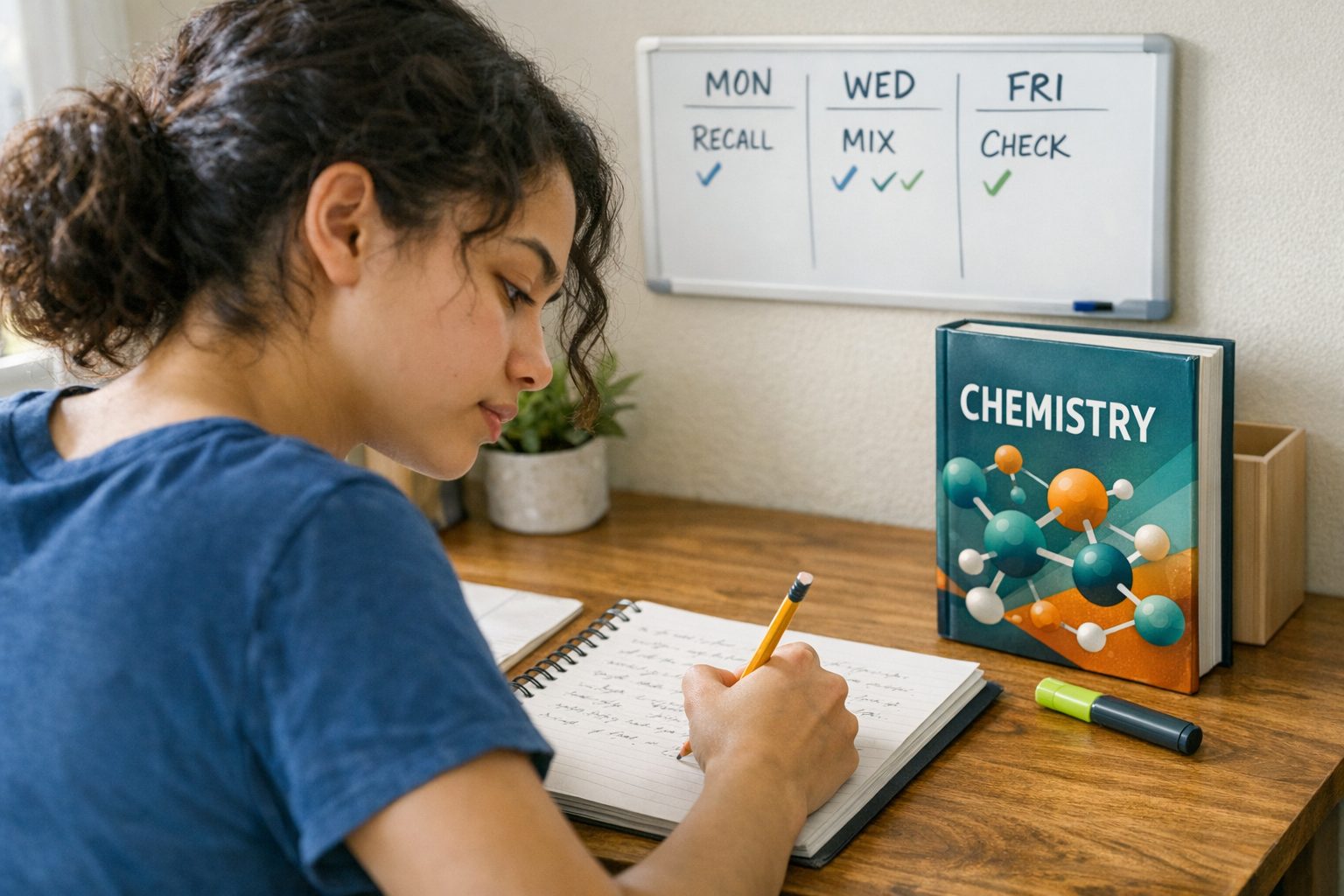
A highlighted chapter can show effort without showing understanding. When I talk about study techniques that work, that is the distinction I want students and parents to notice: can you use what you studied when the book is closed?
Picture a sophomore preparing for a chemistry test. She reads the chapter, recopies her notes, and highlights nearly every line. This is an illustrative example, not a student's record. She has worked hard, but when she tries a practice problem without her notes, she doesn't know where to begin. The effort deserves credit. The study method needs adjusting.
Retrieving information from memory can feel harder than reading it again. That difficulty can be useful, but frustration alone is not evidence of learning. You need a manageable challenge, a way to check your answers, and time to correct mistakes.
Why Re-Reading and Highlighting Can Mislead You
Highlighting can help you mark important material, and re-reading can help you understand a confusing explanation. The trouble starts when those activities become your entire study plan.
A familiar page feels easier to read. It is tempting to mistake that ease for understanding. But recognizing a paragraph is not the same as explaining its main idea or solving a problem without the worked example beside you.
Tests may ask you to recognize an answer, recall information, explain an idea, or apply a method. Your practice should prepare you for the work you will actually have to do.
Study Techniques That Work: Recall, Space, Mix, Explain
Active recall. Close the book and try to bring the information back from memory. My favorite version is the blank page method: after reading a section, close everything and write down the main ideas you remember. Then open the book and check both what you missed and what you got wrong. Review those gaps and try recalling the material again later.
Match the recall task to the subject. For chemistry, you might explain a concept or solve a problem without looking at the example. Flashcards work for definitions and formulas, as long as you answer before flipping the card. They do not replace practicing how to use those formulas.
Spaced practice. Return to material across separate study sessions instead of saving all your work for the night before the test. Start each session by trying to recall something from an earlier one. Check it, work on what needs attention, and revisit it later. Do not drop a topic permanently just because you got it right once.
Interleaving. Once you understand the basics of individual problem types, mix related types during practice. For example, practice solving linear equations alongside quadratic equations rather than doing only one type at a time. Before calculating, ask, "Which method fits this problem, and why?" That choice is part of what you need to practice.
Mixed practice can feel harder because the method is no longer announced by the worksheet heading. If you cannot solve a type of problem at all, though, pause and study a worked example. Practice that skill on its own before returning to the mixed set.
Explain it out loud. Ask yourself, "Why does this step work?" or "How does this connect to what we learned earlier?" Then explain it to a sibling, a friend, or the family dog. Getting stuck can reveal a gap, but sounding confident does not prove you are correct. Check your explanation against your notes, textbook, or a teacher's feedback.
What a Week of Real Studying Looks Like
Here is how I would lay out a starting plan for a test on Friday. Adjust the workload to the size of the unit and what you already understand.
Monday: Try about twenty minutes of closed-book recall and practice on the first part of the unit. Check your work and mark anything missing or incorrect. If you cannot start a problem, review an example and then try a similar problem without looking.
Tuesday: Begin by revisiting Monday's trouble spots from memory. Then work on the rest of the unit. Make flashcards for facts or definitions that need attention, and keep a separate list of problems to retry.
Wednesday: Try a mixed set from across the unit. Check each answer and identify the cause of each mistake: a missing concept, a calculation error, or choosing the wrong method. Correct the work, then retry a similar problem without the solution beside you.
Thursday: Do a short practice quiz in the format you expect on the test, using only the resources the teacher allows. Review errors and revisit earlier material, including some items you previously answered correctly. Then go to bed on time.
Sleep supports learning and memory. Do not make an all-nighter the backup plan. If you find a gap on Monday, ask your teacher for help while there is still time to practice the explanation.
The Hard Part Isn't Knowing How to Study Effectively
Re-reading feels smooth. Recall makes the gaps visible, which can feel discouraging. Researchers at UCLA's Bjork Learning and Forgetting Lab describe certain learning challenges as "desirable difficulties": conditions that can make practice feel harder while supporting longer-term learning. The important word is desirable. Being completely lost is not the goal.
For parents, try replacing "Did you study?" with "Want me to quiz you?" Use the student's notes or an answer key, give them time to answer, and treat errors as information rather than a reason to lecture.
If your child turns a difficult session into a judgment about their ability, offer a more useful phrase: "You're out of practice with these problems. Let's find the step that needs work." That gives you something specific to address.
You may know the material well enough to help. You may also find that your teenager would rather discuss it with someone who is not a parent. If the chemistry or algebra is unfamiliar to you, you do not need to reteach it yourself.
This is a natural place for High Performance Tutoring to help. A tutor can review the student's work, ask them to explain their reasoning, and help identify what needs practice or a fresh explanation. If your child is skeptical, the first hour is free, with no commitment, so they can see whether working with a tutor is useful. Here is how our tutoring works.
Return to the student with the rainbow textbook. The useful next step is not to ban highlighters. It is to close the book, attempt a chemistry problem, and check the reasoning. Progress means being able to explain the concept and solve a similar problem independently, not simply recognizing the page.
Frequently Asked Questions
What is the best way to study for a test?
I would start with active recall spread across separate sessions, then add practice that matches the test. For math and chemistry, that means solving problems, not just memorizing definitions. Begin early enough to ask questions and revisit mistakes before test day.
How long should a study session be?
Try a manageable block, such as twenty minutes, with a specific goal: explain a concept from memory or solve and check a practice set. Adjust from there. If you are rushing, losing focus, or repeating mistakes without understanding them, take a break or get help rather than adding time for its own sake.
Is re-reading ever useful?
Yes. Re-read when you need to understand an explanation or check something you missed. Then close the book and see whether you can explain or apply it. Use re-reading to repair a gap, not as your only evidence that you know the material.
Do flashcards count as active recall?
Yes, as long as you answer before flipping the card. Glancing at the front and immediately flipping to the back is just re-reading in a smaller format. For anything you must apply on a test, add application practice too.
You do not need to change every study habit tonight. Start with the next assignment: close the notes, try it yourself, check your work, and put the difficult material on tomorrow's practice list.
If your child needs help turning these techniques into a workable plan for math or science, reach out to High Performance Tutoring. Your first hour is free, so you can see whether it works for your family.