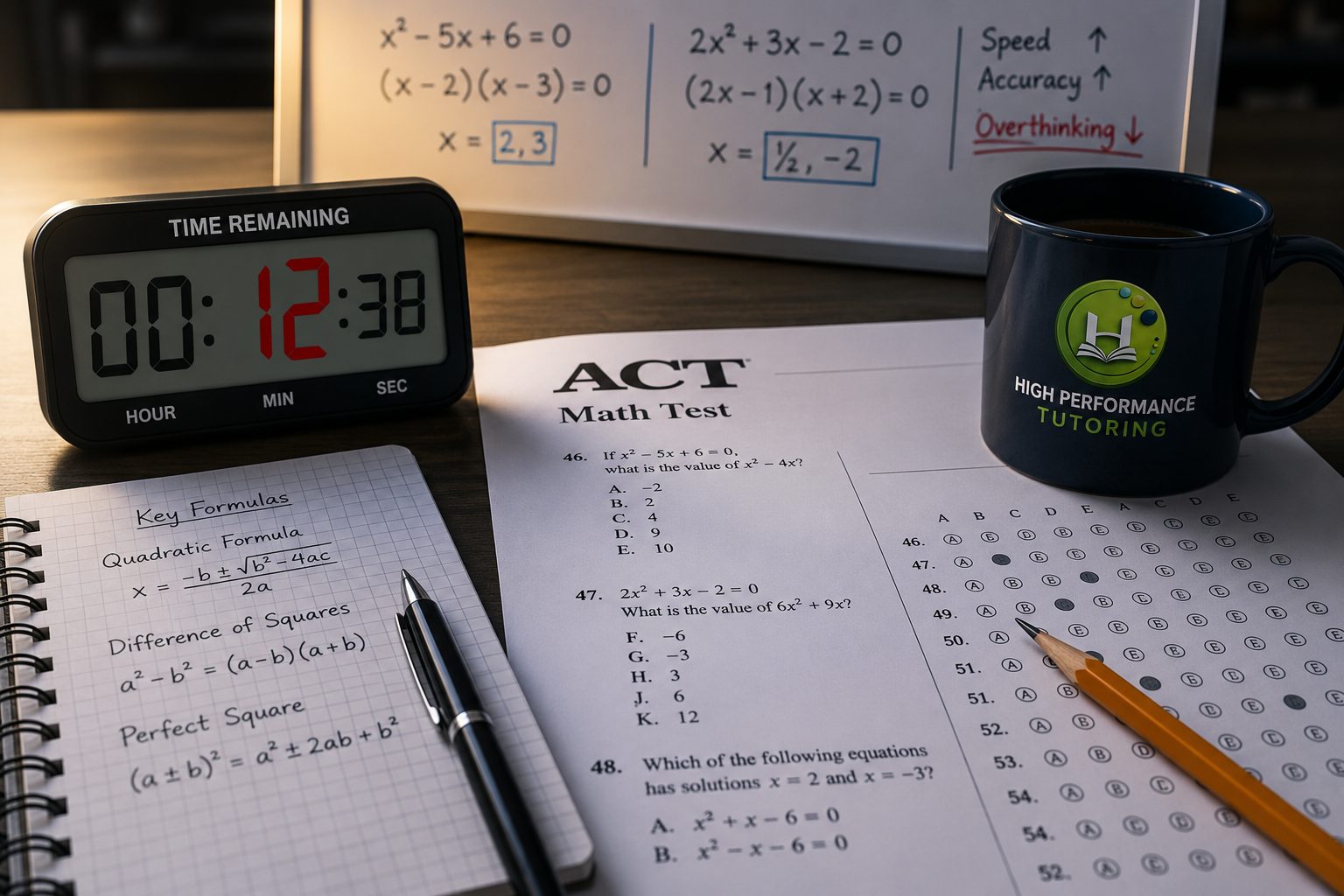
Almost every student I meet who wants to improve their ACT Math score assumes they simply need to learn more math. Strong mathematical knowledge certainly helps, but it isn't the whole story. In fact, some of the brightest math students I work with are surprised when their ACT Math score falls well below their expectations. The reason is that the ACT measures more than whether you know the material; it also measures how efficiently you can apply it under strict time constraints.
On the Enhanced ACT, you'll have 50 minutes to answer 45 math questions. That may sound manageable, but many questions are designed to tempt students into spending far too long on a single problem. High school math classes naturally emphasize understanding concepts and showing your work. The ACT, on the other hand, rewards students who can recognize patterns quickly, choose efficient solution methods, know when to move on, and manage their time strategically. Students who master these skills often see substantial score increases without learning a single new area of mathematics.
Why Pacing Is the Whole Game
Let me show you the math on the math. Say a student is scoring around a 22. When I look at their answer sheet, the pattern is almost always the same: they got most of the first 35 questions right, they slowed way down in the middle, and they either guessed or ran out of time on the last 15. Their raw knowledge was good enough for a 27. Their pacing capped them at a 22.
So the first thing I want you to do is not open a textbook. I want you to time yourself. Take a real practice section and, every 10 questions, glance at the clock. You should be at question 10 by the 9-minute mark, question 20 by minute 18, question 30 by minute 27, and question 40 by minute 36. If you are behind at any checkpoint, you are spending too long on early questions that you already know how to do.
The two-pass method. This is the technique I teach every student. On your first pass, do every question you can answer in under a minute. The moment a problem makes you think "this is going to take a while," circle it and move on. Do not fall in love with a hard problem. When you reach the end, come back and spend your remaining time on the circled ones. You would be amazed how many students leave 3 or 4 easy questions unfinished at the end because they burned six minutes wrestling with one ugly geometry problem in the middle. Never let a single hard question cost you three easy ones.
There is no penalty for guessing. Read that again. A blank answer and a wrong answer are worth exactly the same on the ACT. So there is no excuse for ever leaving a bubble empty. In the last 30 seconds of the section, fill in every remaining bubble with the same letter. Statistically, you will pick up a couple of points for free. I have seen this alone move a student's score up a full point.
The Calculator Trap
Students love their calculators a little too much. The ACT lets you use one on the entire math section, and that is precisely why it can slow you down. I watch students type 3 times 4 into a calculator. That habit costs seconds on every problem, and seconds are the currency of this test.
Use the calculator as a tool, not a crutch. It is genuinely useful for messy arithmetic, decimals, and fractions. But if you are reaching for it to do things you could do in your head, you are training yourself to be slow. Before test day, practice doing the simple stuff on paper. Save the calculator for the moments it actually saves you time.
The Handful of Topics That Actually Show Up
Here is something that should make you feel a lot better. The ACT math section is NOT a random sample of all mathematics you've learned since the 6th grade. The same categories appear on every single test. If you master a short list of topics, you cover the overwhelming majority of the questions. According to the test maker's own breakdown, algebra and functions dominate the section. So focus your studying where the points live:
1. Algebra and equations. Solving for x, systems of equations, inequalities, and substituting values. This is the biggest chunk of the test. If you are shaky here, this is where you get the most points back per hour of study.
2. Percentages, ratios, and proportions. These show up constantly, often disguised in word problems about discounts, mixtures, unit conversion, and rates. They are not hard once you recognize them, but students routinely misread them under time pressure.
3. Coordinate geometry. Slope, the equation of a line, distance and midpoint. A predictable set of formulas that reward memorization.
4. Plane geometry. Triangles, circles, angles, and area. The ACT does not give you a formula sheet, so you need these memorized cold.
5. A little trigonometry. Usually four to six questions involving SOH-CAH-TOA and basic identities. Many students skip trig entirely and leave easy points on the table. Learn just the basics and you grab most of them.
The hardest ACT math topics — logarithms, matrices, complex numbers, ellipses — each appear only once or twice per test. If you are chasing a 34+, learn them. If you are trying to move from a 20 to a 27, ignore them completely and pour your time into the five categories above. I would rather you be flawless on the common topics than dabble in the rare ones.
How to Stop Losing Easy Points
The most painful points to lose are the ones you knew how to get. Here is where they leak out:
Read the last line of the question twice. The ACT loves to make you solve for x and then ask for 2x + 1. You do all the work correctly, then bubble in the value of x. Underline what the question is actually asking for before you start.
Write down your steps. Students who do everything in their head make careless sign errors. The test booklet is scratch paper — use it. A little organization on the page prevents the dumb mistakes that quietly cost 2 or 3 points a test.
Plug in the answers. When you are stuck on a multiple-choice algebra problem, remember that one of the four answer choices is correct. Test them. Working backward from the answers is often faster than solving forward, and it is nearly foolproof.
Frequently Asked Questions
How much can I realistically raise my ACT math score?
With consistent, targeted practice over a semester, jumps of 3 to 10 points are common, and I have seen students gain more when pacing was their main problem. You can see real student gains on our results page.
What is the fastest way to improve my ACT math score?
Fix your pacing first. Most students already know more math than their score reflects — they are simply running out of time and losing easy points at the end. Timed practice with the two-pass method usually produces the quickest gains.
Do I need to memorize formulas for ACT math?
Yes. Unlike some tests, the ACT does not provide a formula reference. Memorize your geometry area formulas, the slope and distance formulas, and basic trig ratios before test day.
Is a calculator allowed on the ACT math section?
Yes, a calculator is permitted on the entire math section, but overusing it slows you down. Save it for messy arithmetic and use mental math for the simple stuff.
The Real Secret
The students who improve the most are not the ones who learned some hidden trick. They are the ones who stopped treating the ACT as a math test and started treating it as a timed strategy game that happens to use math. The concepts are the concepts — most of them you learned by tenth grade. What separates a 22 from a 29 is pacing, discipline, and knowing where the points actually are. Every student I have worked with is capable of that. It is a skill, and skills can be trained.
If you'd like a hand building this into a real plan, our ACT prep course and our math tutors do exactly this kind of targeted coaching, and your first hour with us is completely free. Your child's education is our first priority :)