
Call

How to Build an SAT Study Plan

A practical plan for the digital SAT: start from a real practice score, set a target, study the way research suggests works best, and keep nerves in check on test day. With a free printable study-plan template.

A tutor working one-on-one with a student on SAT prep

Updated November 2026 by the High Performance Tutoring SAT team. Study and anxiety research is cited below; College Board details are linked to the official pages.

  1. Take a baseline

    A full Bluebook practice test, timed.

  2. Set a target

    From your colleges' score ranges.

  3. Find the gaps

    Read the score report by skill.

  4. Plan backward

    From test day to this week.

  5. Practice like test day

    Timed, mixed, and logged.

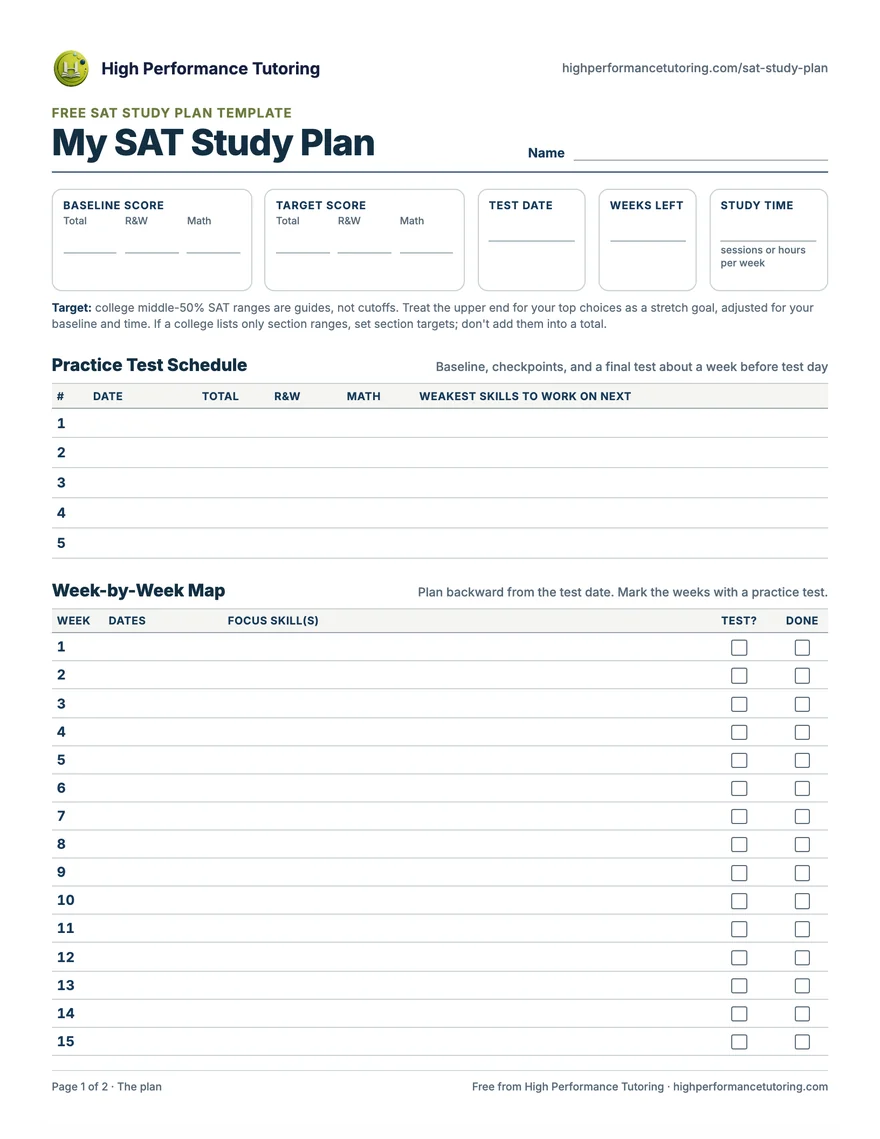
Page 1 of the SAT study plan template: baseline and target scores, test date, weeks left, a practice test schedule, and a week-by-week map.
Page 1 of 2. Page 2 is a weekly session planner and an error log.
Free Printable

Free SAT Study Plan Template

Put your study plan on two printable pages: an overall schedule, a weekly planner, and an error log. Fill in your numbers once, map the weeks backward from your test date, then copy page 2 for each week.

  • Your baseline score, target score, test date, and weeks left
  • A week-by-week map with a focus skill and a practice test schedule
  • A weekly session planner: what you'll practice, for how long, and a checkbox
  • An error log for missed questions (and ones guessed right), with the reason and the fix

US Letter, 2 pages, prints cleanly in black and white. Free, no email needed. The online version saves your entries in your browser only.

The Starting Point

Start From Data, Not a Guess

A plan is only as good as its starting point. Four steps turn one practice test into a plan.

  1. Take a full practice test in Bluebook

    Before you plan anything, take one of the free full-length practice tests in the College Board's Bluebook app, timed, in one sitting. It uses the same adaptive format, tools, and built-in Desmos calculator as the real test, so the score is a useful starting point. Try Bluebook's short test preview first if the tools are new to you, but don't cram for the test itself: you want an honest picture of where you are.

  2. Set a target from real college score ranges

    Look up the middle 50% SAT range (the 25th to 75th percentile) for each college on your list, on its admissions site or in the U.S. Department of Education's College Navigator. These ranges describe recent students who reported scores; they are not cutoffs or guarantees. The upper end for your top choices makes a good stretch target, adjusted for your baseline and the time you have. If a college lists only section ranges, set a target for each section rather than adding them into a total. The gap doesn't have to split evenly: aim more of it at the section with more room to grow.

  3. Read the score report by skill, not just the total

    After a practice test, open your results in My Practice. Look past the total: the report shows how you did in each content area, and you can review every question you missed. College Board's score reports break the test into eight content domains, four in Reading and Writing and four in Math. Your two or three weakest domains are where your first weeks of study should go.

  4. Plan backward from the test date

    Write the test date at the bottom of the calendar and work up. Put the last full practice test about a week before test day, and keep the final two days light. Space the other practice tests evenly, then fill the weeks between them with short sessions on your weak skills. Count how many weeks you really have, including busy ones.

Example: from score report to this week's plan

  1. The report: Math's Advanced Math domain is the weakest. Reviewing the misses shows most are quadratics.
  2. Focused set: Two sessions on quadratics: in the Student Question Bank, filter Advanced Math to its nonlinear equations and nonlinear functions skills, and pick the quadratic questions.
  3. Mixed set: One session mixing quadratics with older skills, so you practice choosing the method.
  4. Redo: Log every miss. A week or two later, redo them without the answers. Still missing them? That skill stays on next week's plan.
Back to topics ↑
Study Habits

How to Study: Four Habits That Work

How you spend your study hours matters as much as how many you put in.

Practice testing beats rereading

Answering questions from memory, then checking, builds more lasting learning than rereading notes or highlighting. A large review of study techniques rated practice testing one of the most useful and rereading and highlighting among the least. For the SAT, that means most of your time goes to real questions, not to watching or reading about them.[1, 2]

Short, frequent sessions beat cramming

Research on spacing suggests that the same total study time works better split into sessions spread over days and weeks than crammed into a few long ones. In practice, that might mean three hours a week as four 45-minute sessions rather than one long Saturday. Come back to old skills every week or two so they stay fresh.[1, 3]

Mix question types once the basics are in

Doing ten of the same kind of problem in a row feels productive, but the test never tells you which skill a question needs. Studies of mixed (interleaved) practice in math suggest that shuffling problem types helps students learn to choose the right method. Learn a skill in a focused set, then practice it inside mixed sets.[1, 4]

Keep an error log

Write down every question you miss (and any you got right by guessing): where it came from, the skill, why you missed it, and the rule or step that would have saved it. Then redo those questions a week or two later without looking at the answer. Your error log becomes your personal study guide, and it shows you patterns a score never will.

For each miss in your error log, name the reason. Each one has a different fix:

Why I missed itThe fix
Didn't know itLearn the rule or method, then do a short focused set.
Misread itUnderline what the question asks before you answer.
Careless slipFind the step where it went wrong; add a quick check there.
Ran out of timePractice the pacing plan; skip and return instead of stalling.
Back to topics ↑
Free Resources

The Free Official Tools

The best practice material for the digital SAT comes from the College Board, and it's free.

Bluebook practice tests

Free, full-length, adaptive practice tests in the same app you'll test in. Save them for your baseline and checkpoints, not everyday practice. A test you've already seen is fine practice but no longer a fair measure of progress.

Get Bluebook →

My Practice and the Student Question Bank

Your practice-test results live in My Practice. The Student Question Bank filters questions by section, domain, skill, and difficulty, which is ideal for your weekly skill sessions.

Open My Practice →

Official SAT Prep on Khan Academy

Free lessons and practice built with the College Board, organized by skill. Good for relearning a topic before you drill it.

Visit Khan Academy →

Free from us, too: live weekly SAT workshops on Zoom, with practice sets posted after each one, and study guides for every part of the test.

Back to topics ↑
Dress Rehearsal

Practice in Test Conditions

Matching test-day conditions makes your practice score a more useful estimate.

  • Take full practice tests in Bluebook, on the device you'll bring on test day.
  • Sit for the whole test in one go with the real timing: two 32-minute Reading and Writing modules, a 10-minute break, then two 35-minute Math modules.
  • Start in the morning, at about the time the real test starts.
  • Phone in another room, no music, no pausing to look things up.
  • Use what you'll have on test day: Bluebook's Desmos calculator and reference sheet, scratch paper and a pencil, and your own approved calculator if you plan to bring one. If you have approved accommodations, practice with them.
  • Afterward, rest. Then review every miss within a day or two, while you still remember your thinking.

New to the format? The Digital SAT Playbook covers the adaptive modules, the Bluebook tools, and a pacing plan.

Back to topics ↑
Sample Plans

Sample SAT Study Plans by Time Left

Two starting points. Adjust them to your baseline, your target, and your calendar.

About 3 weeks

4 to 5 sessions a week of 45 to 60 minutes; two full practice tests in all

Three weeks is enough to fix a few high-value skills and lock in pacing, not to relearn everything. A full test takes a morning: it replaces that day's session, and reviewing it replaces the next one.

Week 1

  • Full Bluebook practice test (if you haven't taken one).
  • Log every miss. Pick your two or three weakest skills.
  • Short focused sessions on those skills, plus the Desmos moves you'll use most.

Week 2

  • Timed, mixed question-bank sets in both sections.
  • Redo last week's error-log questions without the answers.
  • Second full practice test at the end of the week.

Week 3

  • Review the second test the day after.
  • Short mixed sets; final error-log redo.
  • Last two days: light review, test-day checklist, normal sleep. No full test the day before.

About 2 to 3 months

3 to 4 sessions a week, plus a full practice test about every 3 to 4 weeks

The ideal runway: time to build skills, mix them, and check progress. Practice tests run on their own every-3-to-4-weeks rhythm, not on the phase boundaries. With 8 weeks, for example: the baseline in week 1, a checkpoint around week 4, and the final test around week 7.

First 2 weeks: plan

  • Baseline practice test, target score, and the plan on paper.
  • Start the error log. Begin with your weakest content domain.

Next 3 to 6 weeks: build skills

  • Skill blocks: one or two domains per week, in focused sets.
  • Each week ends with a mixed review set of everything so far.
  • Take a checkpoint test when one is due, then update the plan.

Next 2 to 3 weeks: mix and time

  • Mostly timed, mixed sets. Weak spots get extra sessions.
  • Redo error-log questions every week.

Final 1 to 2 weeks: sharpen

  • Final practice test about a week before test day (it can be your last checkpoint).
  • Short mixed sets and error-log redos; pacing practice.
  • Taper the last two days. Plan test-day logistics.

The catch: a plan you can't keep is worse than a smaller one you can. If a week falls apart, don't try to make it all up. Move the focus skill to next week and keep the practice test dates.

Back to topics ↑
When the Score Stalls

Breaking Through a Plateau

First, a reality check: scores move a little from test to test on their own. College Board's score reports show a score range for exactly that reason. A plateau is several tests in a row with no real gain. When that happens, change how you practice, not just how much.

Practicing what you already know

Easy sets keep skills fresh, but they rarely fix what's holding your score back. Sort your error log by skill and spend your next week on the skill with the most misses.

Doing questions without reviewing them

Much of the learning happens in the review. For each miss, write why it happened and redo it later. Leave time to understand your mistakes instead of chasing a bigger question count.

The same kind of mistake, again

Tally your error log by reason. If most misses are misreads or careless slips, the fix is a habit (underline the question, check the last step), not more content.

Testing too often

A full test every few days leaves no time to fix anything between them. Give each practice test at least a week or two of targeted work before the next one.

Back to topics ↑
Test Anxiety

Managing Test Nerves

Some nerves are normal, and practicing in test conditions makes test day feel familiar. Here are four optional strategies to try during practice. The evidence varies by strategy and none is a guaranteed fix, so keep what works for you.

Reframe the nerves

A racing heart before a test is a normal stress response. It doesn't mean you'll do badly. Some studies suggest that reading those feelings as energy, rather than as a warning, can help. In one, college students told this before a GRE practice test did better on the math section.[5]

Try it: Say to yourself: “This is my body getting ready.”

Slow your breathing

Slow, steady breathing is one of the simplest ways to settle down. Research on slow breathing links it to feeling calmer and more relaxed, though the studies are small and varied.[6]

Try it: Breathe slowly at a pace that feels comfortable, for example in for about four counts and out for about six, for a minute.

Write the worries down

A well-known 2011 study found that students who wrote about their test worries for about ten minutes right before an exam did better. But a 2025 review of 21 studies found little effect on anxiety or scores overall. So treat it as optional: some students find that getting worries onto paper helps them set them aside.[7, 8]

Try it: Before a practice test, write for a few minutes about what's worrying you. Keep the habit only if it helps.

Reset in the freeze moment

Everyone blanks on a question sometimes. Hard questions are part of the test, not a sign you're failing. The skill is not to let one question cost you three.

Try it: Take one slow breath, enter your best guess (there's no penalty for guessing), mark the question for review, and move on. Come back to it before the module ends if time allows.
Back to topics ↑
For Parents

How Parents Can Help

Lower the pressure, keep the plan

  • Ask about the plan, not the score: “What are you working on this week?”
  • Take the logistics off their plate: registration, the device, the route, and a snack for the break.
  • Keep the night before ordinary: a normal dinner, no cramming, a regular bedtime.
  • Remind them the SAT can be taken again. One test day does not decide their future.
  • Notice the effort and the habits, not just the number.

Testing accommodations

Students with a documented disability may qualify for accommodations on the SAT, such as extended time or extra breaks. College Board's Services for Students with Disabilities decides each request, and it recommends going through the school, usually with the school's SSD coordinator. Eligibility is decided case by case, and ordinary test nerves alone don't qualify. Start well before test day: College Board says review can take up to seven weeks, and longer if more documentation is needed, so check the request deadline for your test date. Details are on the College Board accommodations site.

When it's more than nerves

If worry about tests is constant, brings on panic, disrupts sleep or eating, or spills into the rest of school life, a study plan isn't the fix. Talk with the school counselor or your child's doctor. Help is available, and it's fine to ask early.

Back to topics ↑
One-on-One SAT Prep

Want a Plan Built for Your Student?

The template works on its own. Where families often want help is the diagnosis: reading a practice test and knowing which few skills will move the score fastest, then adjusting the plan as results come in. That is what our SAT tutors do. They study the test itself, score highly on it, and have taught it to many students. Learn more about our one-on-one SAT prep, or start with a free 30-minute consultation by phone or Zoom.

Book Your Free ConsultationFree 30-minute call by phone or Zoom. No commitment.

Research cited on this page

  1. [1]Dunlosky, Rawson, Marsh, Nathan & Willingham (2013), Improving Students' Learning With Effective Learning Techniques, Psychological Science in the Public Interest
  2. [2]Roediger & Karpicke (2006), Test-Enhanced Learning, Psychological Science
  3. [3]Cepeda, Pashler, Vul, Wixted & Rohrer (2006), Distributed Practice in Verbal Recall Tasks, Psychological Bulletin
  4. [4]Rohrer & Taylor (2007), The Shuffling of Mathematics Problems Improves Learning, Instructional Science
  5. [5]Jamieson, Mendes, Blackstock & Schmader (2010), Turning the Knots in Your Stomach into Bows: Reappraising Arousal Improves Performance on the GRE, Journal of Experimental Social Psychology
  6. [6]Zaccaro et al. (2018), How Breath-Control Can Change Your Life: A Systematic Review on Psycho-Physiological Correlates of Slow Breathing, Frontiers in Human Neuroscience
  7. [7]Ramirez & Beilock (2011), Writing About Testing Worries Boosts Exam Performance in the Classroom, Science
  8. [8]O'Meara & Lovett (2025), Single-Session Expressive Writing Interventions for Test Anxiety: A Meta-Analysis, Anxiety, Stress, & Coping

This guide is general study advice from tutors. It is not medical or mental-health advice. Test policies can change; check College Board's official pages before test day.

SAT and Bluebook are trademarks registered by the College Board. Khan Academy is a registered trademark of Khan Academy. Neither organization is affiliated with or endorses High Performance Tutoring.

SAT Study Plan FAQ

It depends on the gap between your baseline and your target and on how much time you have. Two to three months of steady practice is a comfortable runway for most students; three weeks is enough to fix a few high-value skills and practice pacing. Start from a practice test score, not a guess.

Enough to measure progress, with time to improve between them: a baseline, one or two checkpoints, and a final test about a week before test day. Leave at least a week or two of targeted practice between full tests.

About 45 to 60 minutes on one or two skills: a short focused set, a mixed set that includes older skills, and a few minutes logging and redoing your misses.

Yes. Download the PDF and print it, or fill it in on screen and print it from your browser. No account or email needed.
Get the template →

Accommodations are for students with a documented disability, and College Board decides each request based on the documentation. Talk with your school's counselor or SSD coordinator about whether a request makes sense for your student, and start early: College Board says review can take up to seven weeks, and longer if more documentation is needed.

Last updated November 2026

Your Journey Starts Here

Interested in One-on-One SAT Prep?

Book your free consultation to discuss your student's test, timeline, and prep options.

First Tutoring Hour Free Top 5% of Tutor Applicants

Our best students have gained 300+ SAT points; most who complete our program gain 150 to 300. Individual results vary with starting score, effort, and time invested.

★★★★★

“We've been very impressed with the methodical, detailed tutoring by Ingo. He's been working with our son on his SAT and ACT prep. Extremely pleased so far!”

Kim T., East Bay Parent · Google review

Prefer to talk? Call (801) 508-4080

Book Your Free SAT Consultation

Free 30-minute call by phone or Zoom. No commitment.

4.9 from 63 Google reviews · 3,700+ students served