The question I get asked more than almost any other is a simple one: "What is a good SAT score?" Parents ask it in hushed, worried tones, as if there is some secret number that separates the successful kids from the rest. Students ask it hoping I'll tell them they can stop studying. And here is the honest truth I have learned over 20 years of preparing students for this test: there is no single good SAT score. There is only a good score for the colleges your son or daughter actually wants to attend. Once you understand that, the whole thing gets a lot less scary.
Let me demystify the number for you.
How the SAT Score Actually Works
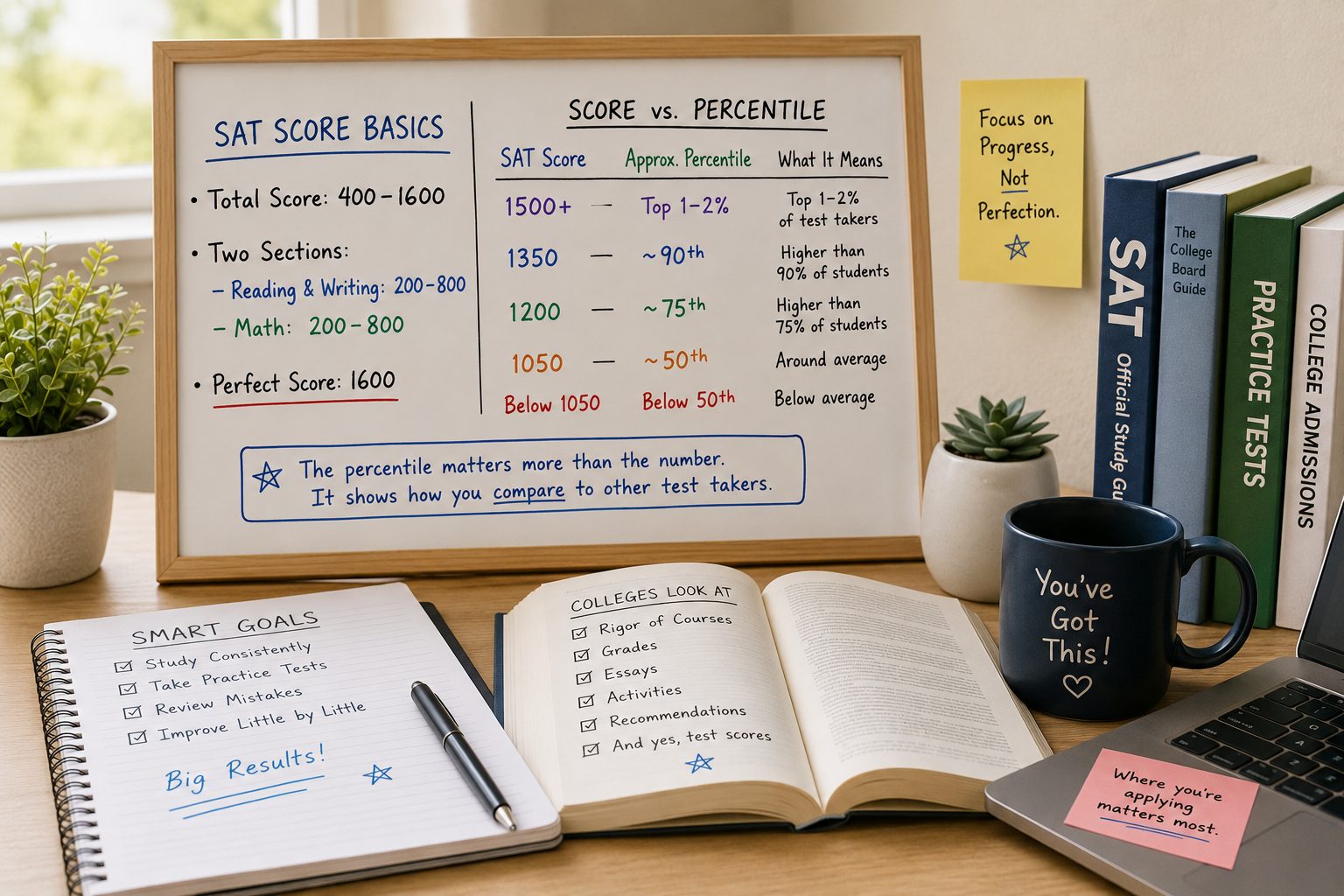
The SAT is scored on a scale from 400 to 1600. That total is the sum of two sections: Reading and Writing, and Math, each scored between 200 and 800. A perfect score is 1600. That much most families already know. What they don't know is that the raw number matters far less than the percentile attached to it.
The percentile tells you what fraction of test takers you scored higher than. According to the College Board, the average SAT score hovers right around 1050. So a 1050 puts you at roughly the 50th percentile—smack in the middle, better than half the students who took the test. A 1200 lands you near the 75th percentile. A 1350 is around the 90th percentile, meaning you outscored nine out of ten test takers. And a 1500 or above puts a student in the top 1 to 2 percent in the entire country.
I share these numbers not to make anyone feel behind, but to give you a map. When a parent tells me their child got a 1150 and asks, worried, whether that's "bad," I get to tell them the truth: it's above average. Whether it's good is a completely different question—and that depends entirely on where they're applying.
A Good SAT Score for College Depends on the School
Here is the reframe that changes everything. There is no universal passing grade on the SAT. Instead, every college publishes the middle 50 percent of scores for its admitted students—the range between the 25th and 75th percentile of the class that got in. That range is your real target.
To give you a rough sense of what a good SAT score by school looks like:
Highly selective schools (the Ivies, Stanford, MIT, Caltech) admit students who mostly score between 1470 and 1580. At these schools, even a 1450 is on the lower end of the range.
Strong flagship universities and selective private colleges tend to admit students in the 1250 to 1450 band. A score in the low 1300s makes you a genuinely competitive applicant at a huge number of excellent schools.
Solid state universities and many good regional colleges often see admitted students in the 1050 to 1250 range. That means an average or slightly-above-average score opens the door to a fantastic education and, very often, meaningful scholarship money.
So when your child asks what a good SAT score is, the correct answer is a question back: "Good enough for where?" Make a list of the schools they care about. Look up each one's middle-50 range—it takes about ten minutes online. Then aim to land at or above the 75th percentile of that range. Do that, and the SAT stops being a source of dread and becomes a solvable target.
How to Close the Gap Between Your Current and Target Score
Once you know your target, the work becomes clear. You have a current score and a goal score, and the whole game is closing the distance between them. Over the years I have watched hundreds of students do exactly this, and the ones who succeed all follow the same pattern.
1. Get an honest baseline first. Before anything else, have your son or daughter sit down and take a full, timed, official practice test under real conditions—no phone, no snacks every ten minutes, no pausing the clock. This number is the most useful piece of information in the entire process. I have seen students assume they were "a 1100 kid" only to discover they were already at 1240 and much closer to their goal than they feared. You cannot plan a route without knowing your starting point.
2. Attack the section with the most room to grow. Most students are lopsided—stronger in one section than the other. If a student is sitting at 680 in Reading and Writing but 540 in Math, that Math section is where the points are hiding. It is almost always easier to move a 540 up to 640 than to squeeze a 680 up to 720. Spend your energy where the gap is widest.
3. Learn from every missed question. A practice test is worthless if you take it and file it away. The gold is in reviewing every single problem you got wrong and asking why. Was it a content gap you never learned? A careless error? A timing crunch? When students start keeping a simple log of their mistakes and the reason for each, their scores climb, because they stop making the same three kinds of errors over and over.
4. Be consistent, not heroic. The student who does two focused hours a week for ten weeks beats the student who crams twenty hours the weekend before, every single time. The SAT rewards familiarity—with the timing, the question types, the traps. That familiarity only comes from steady, repeated exposure. This is exactly why I built our SAT prep course around a semester-long rhythm rather than a last-minute sprint.
I want to be concrete about what's possible, because the numbers surprise people. I have seen a student go from a 1080 to a 1290 over a summer—enough to move them from the middle of the applicant pool at their dream school to well above it. I've watched a student jump nearly 300 points across a full program of preparation. These weren't naturally gifted test takers. They were ordinary, hardworking kids who found their gap and closed it methodically. You can see more of these real improvements on our results page, and I encourage skeptical parents to look, because these stories are the whole reason I still do this work.
Frequently Asked Questions
What is the average SAT score?
The average SAT score is right around 1050 out of 1600, according to the College Board. That places a student at roughly the 50th percentile—better than half of all test takers.
Is 1200 a good SAT score?
A 1200 is a strong, above-average score that lands near the 75th percentile nationally. It makes a student competitive at a wide range of good colleges and state flagships. Whether it's "good" for a specific school depends on that school's middle-50 range.
How much can you realistically improve your SAT score?
With consistent, targeted preparation over a semester, I regularly see students improve by 150 to 300 points. The single biggest factor is starting early enough to build real familiarity with the test rather than cramming.
Do colleges care more about the score or the percentile?
Colleges evaluate your score against their own admitted-student range, so what really matters is where you fall relative to that school's class. Look up each target college's middle-50 percent and aim for the 75th percentile of that range.
The Number Is Not a Verdict
Here is what I most want families to take away: the SAT score is not a measurement of how smart your child is or how far they'll go in life. It is a solvable problem with a known target and a clear path. The moment a student stops treating the number as a judgment and starts treating it as a goal to be worked toward, the anxiety drains out of it and the real progress begins. I have seen it happen hundreds of times, and it is one of the most satisfying things to watch—a kid who thought they were "just not a good test taker" discover that they were simply a few good habits away from the score they wanted.
If you'd like help figuring out your child's target score and building a plan to reach it, I'd love to talk—your first hour with us is completely free, so there's no risk in finding out where they stand. Your child's education is our first priority :)